Getting a recycling program off the ground takes more than buying bins and posting a flyer. The real challenge is getting people to actually use it—and keep using it month after month. Whether you manage a warehouse, office building, or multi-tenant facility, engaging employees and tenants from the start determines whether your recycling program becomes part of daily operations or just another ignored initiative.
For businesses in California, this isn't optional. State mandates like AB 341 require commercial operations generating more than four cubic yards of waste weekly to recycle. SB 1383 adds organics diversion requirements with enforcement mechanisms that include fines. Beyond compliance, separating recyclable materials—especially heavy items like scrap metal and cardboard—from your general waste stream directly reduces disposal costs.
This guide walks through each phase of launching a workplace recycling program, from initial planning through ongoing maintenance. You'll find practical examples of signage, email templates, and strategies for handling common problems like contamination and low participation.
Planning Phase: Set the Foundation Before You Announce Anything
A recycling program that works starts with decisions made before anyone else hears about it. Skip this phase, and you'll spend months fixing problems that could have been prevented.
Assess What You're Actually Dealing With
Walk your facility and look at what ends up in trash cans. Most commercial operations generate predictable waste streams based on their industry [1]. A retail warehouse produces mountains of cardboard. An auto shop accumulates scrap metal and used batteries. An office building generates paper, aluminum cans, and food containers.
Document what you see:
Primary materials by volume (cardboard, metals, paper, plastics)
Current bin locations and whether they make sense
Areas with the heaviest waste generation
Existing behaviors—good and bad
This assessment tells you where to focus and what infrastructure you need. It also helps you estimate the financial impact: separating heavy recyclables like metal and cardboard from general trash reduces the weight you're paying to haul to landfill.
Understand Your Compliance Requirements
California businesses face specific recycling mandates that drive the urgency behind these programs:
AB 341 requires businesses generating four or more cubic yards of solid waste per week to arrange for recycling services
SB 1383 mandates organic waste diversion and applies to most commercial operations
CALGreen building codes require construction and demolition projects to divert at least 65% of debris from landfills
Non-compliance can result in fines, and for construction projects, failure to document proper recycling can delay final inspections. Having a structured program with clear documentation protects you during audits.
Identify Your Recycling Partner Early
Before announcing anything to staff, confirm you have a reliable way to handle the materials you'll collect. For high-volume scrap metal and cardboard, a mobile recycling service that picks up on-site eliminates the logistics headache of hauling materials yourself [2].
Having your recycling partner in place before launch means you can answer the inevitable question: "What actually happens to this stuff after we put it in the bin?" A credible answer builds trust in the program.
The right partner should also help you understand the economics. For valuable materials like copper, aluminum, and clean cardboard, you may receive compensation that offsets program costs. For lower-value materials, the savings come from reduced general waste disposal fees.
Build Your Internal Team
Assign specific people to own the program. Depending on your facility size, this might be:
A program coordinator who handles communications and tracks progress
Department or floor champions who answer questions and monitor their areas
Maintenance staff who know the pickup schedule and bin locations
Without clear ownership, recycling programs drift into neglect within weeks. Champions don't need to be supervisors—often the most effective advocates are frontline workers who see waste generation daily and can influence their peers.
Launch Phase: Make the First Impression Count
How you introduce the program shapes whether employees and tenants take it seriously or dismiss it as corporate box-checking.
Announce with Purpose, Not Just Information
Your launch announcement should explain the why, the what, and the how—in that order. Leading with the reason builds buy-in before asking for behavior change.
Sample Launch Email:
Subject: New Recycling Program Starting [Date]—Here's What You Need to KnowStarting [date], we're launching a facility-wide recycling program for [cardboard/scrap metal/other materials].Why we're doing this:California law requires businesses like ours to recycle specific materials. Beyond compliance, separating recyclables from general waste reduces our disposal costs and keeps usable materials out of landfills.What's changing:New recycling bins will be placed at [locations][Material type] goes in the [color] binsRegular trash continues to go in [existing locations]What we need from you:Use the correct bins for recyclable materialsWhen in doubt, check the posted signs or ask [contact name]Questions? Contact [name] at [email/extension].
Keep the email short. People skim workplace communications. Put the essential information in the first few sentences.
Use Signage That Actually Works
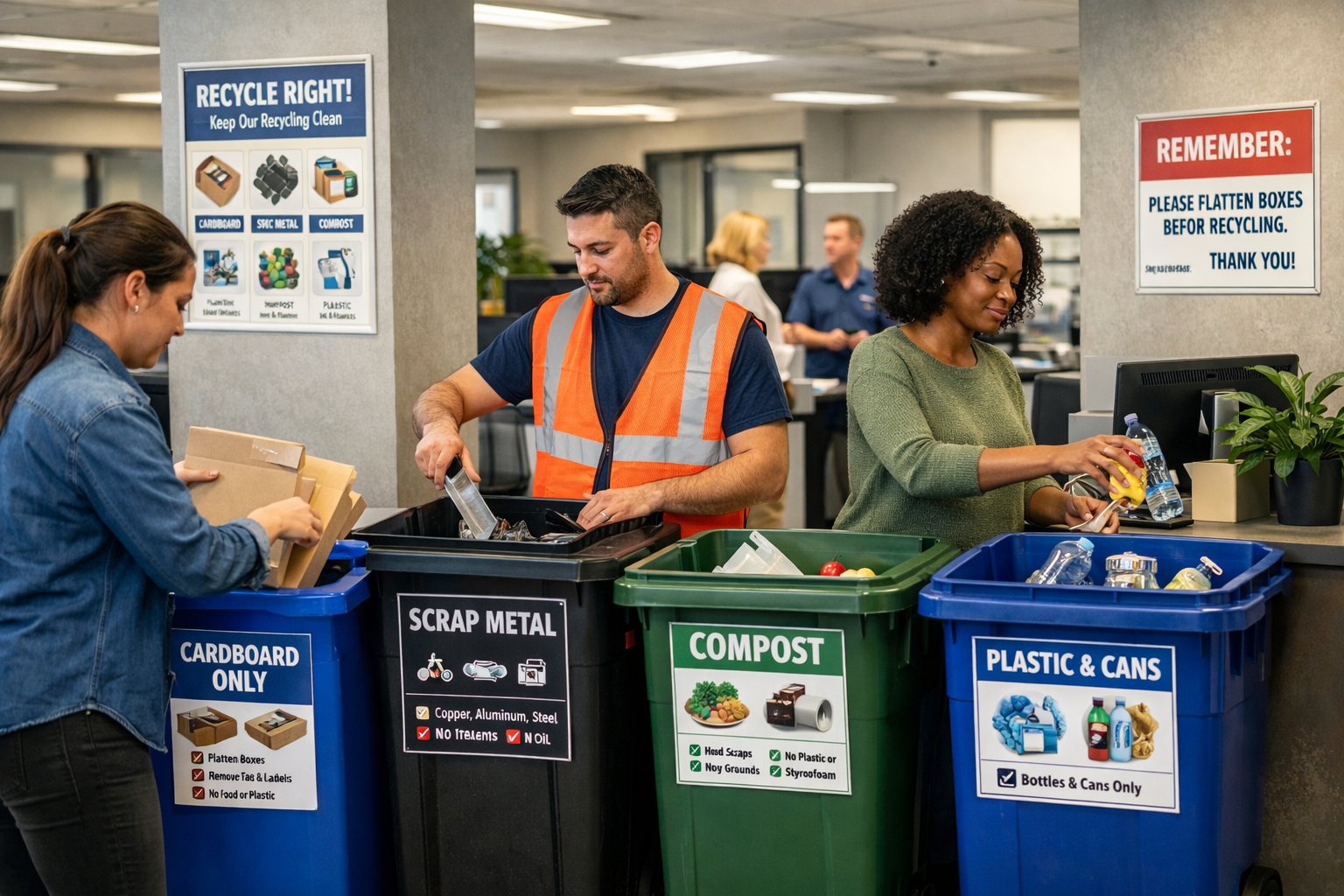
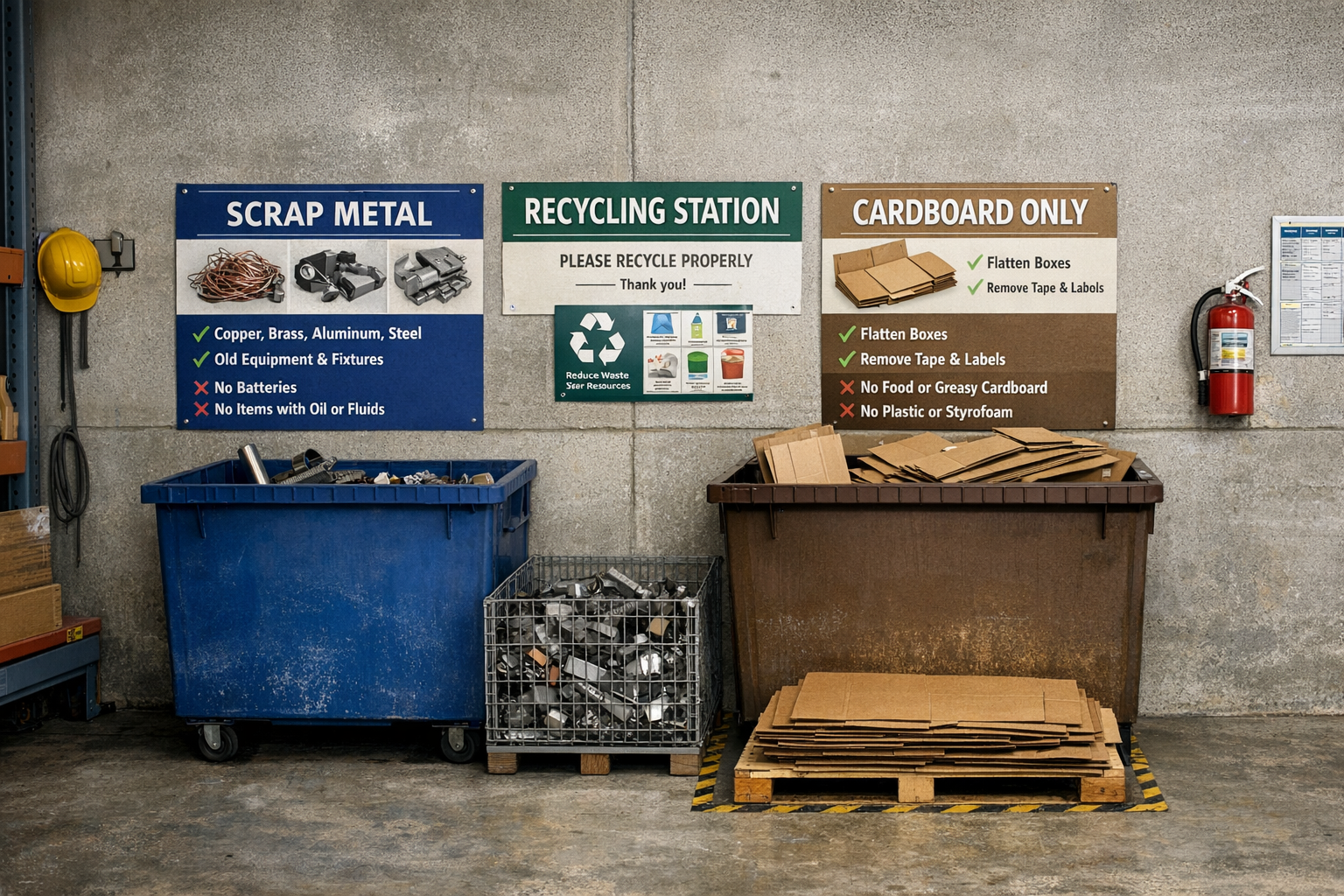
Effective recycling signage follows three rules: show pictures, use few words, and place signs exactly where decisions happen.
Bin Signage Examples:
For a cardboard recycling bin:
CARDBOARD ONLY[Image of flattened cardboard box]✓ Flatten boxes✓ Remove tape and labels when possible✗ No food-contaminated cardboard✗ No plastic packaging
For a scrap metal collection area:
SCRAP METAL[Images of acceptable items: copper wire, aluminum, steel pieces]✓ Copper, brass, aluminum, steel✓ Old equipment and fixtures✗ No batteries in this bin✗ No items with oil or fluids
Post signs at eye level directly above or on the bin. A sign across the room doesn't help someone standing with material in their hands trying to decide where it goes.
Hold Brief Training Sessions
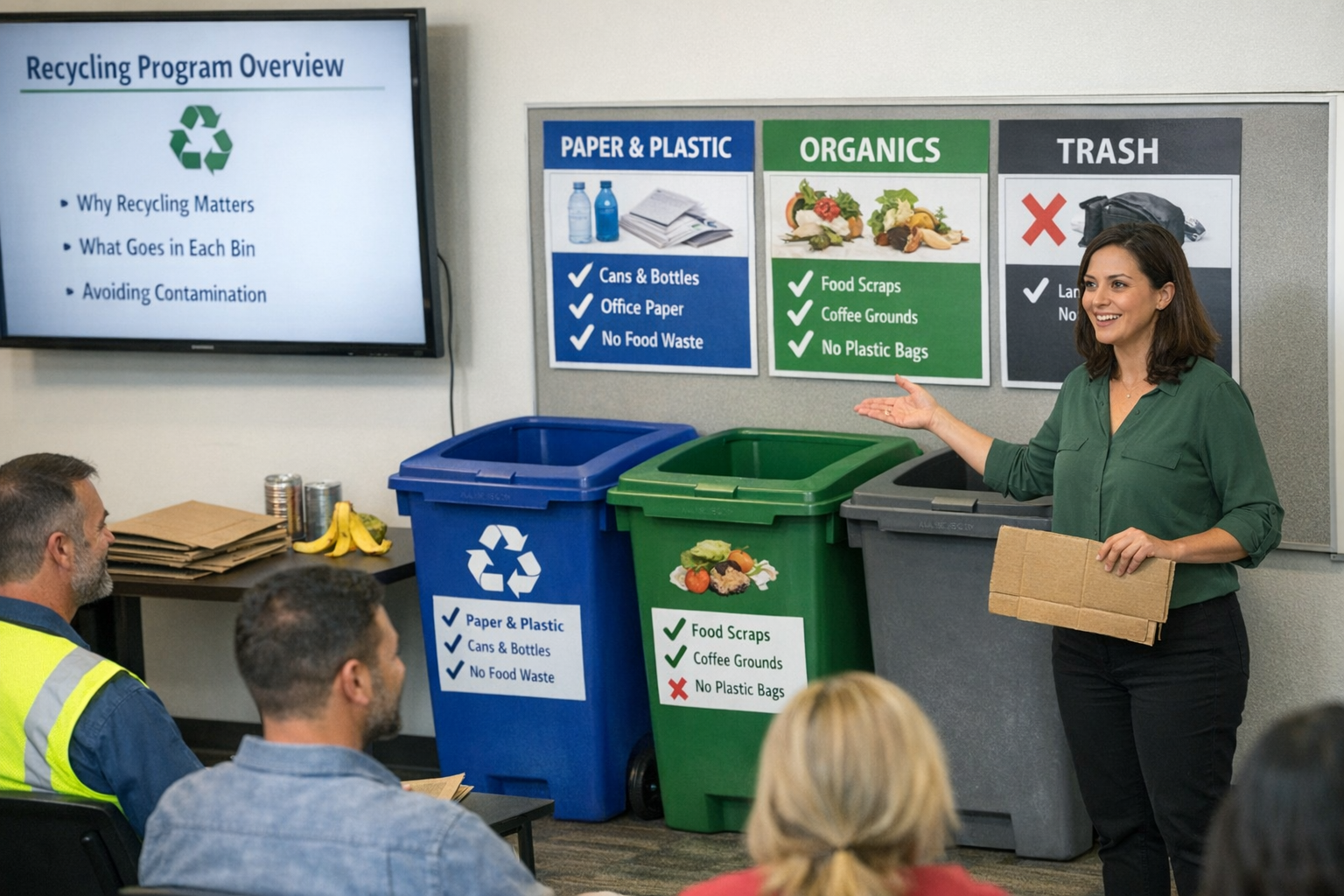
A 10-minute training session prevents weeks of contamination problems. Cover only the essentials:
Where the bins are located
What goes in each bin (with physical examples if possible)
What absolutely cannot go in recycling bins
Who to contact with questions
For multi-tenant buildings, offer sessions at different times to accommodate various schedules. Some property managers find that brief floor-by-floor walkthroughs work better than formal meetings—people engage more when you're standing in front of the actual bins discussing real scenarios.
First 30 Days: Monitor, Adjust, and Reinforce
The first month reveals whether your program design works in practice. Pay attention and make changes quickly.
Check Bins Daily During Week One
Have your program champions physically look at what's going in the bins. You're checking for:
Contamination (wrong materials mixed in)
Overflow (bins filling faster than expected)
Empty bins (poor placement or unclear instructions)
Confusion patterns (same mistake appearing repeatedly)
Document what you find. Patterns tell you where communication failed. If three different people put plastic wrap in the cardboard bin, that's a signage problem, not a people problem.
Send a Follow-Up Message
One week after launch, send a brief follow-up:
Subject: Recycling Program Update—Quick RemindersThanks for participating in our new recycling program. Here are a few things we've noticed this week:What's working well:[Specific positive observation—e.g., "The cardboard bins in the warehouse are being used correctly"]Quick reminders:[Address specific issue you observed—e.g., "Please flatten cardboard boxes before placing in bins—unflattened boxes fill the bin five times faster"][Second reminder if needed]Keep up the good work. Questions? Contact [name].
Acknowledging what's working reinforces good behavior. Addressing problems early prevents them from becoming habits.
Adjust Bin Placement if Needed
If bins aren't being used, the location is probably wrong. Recycling bins need to be:
At the point where waste is generated (not in a back corner)
As convenient as trash cans (ideally right next to them)
Clearly visible and unobstructed
In our experience working with commercial facilities, relocating a bin just a few feet closer to where waste is actually generated can dramatically increase proper usage. People make split-second decisions about where to put things—if the recycling bin requires extra steps, most will default to the closer trash can.
Handling Common Behavior Problems
Every recycling program encounters resistance and mistakes. Here's how to address the most common issues.
Problem: Contamination in Recycling Bins
Contamination—putting the wrong materials in recycling bins—is the most frequent problem. A single bag of food waste can ruin an entire load of cardboard, turning a valuable recyclable into landfill material.
Course correction approaches:
Post "oops" signs when contamination is found, showing specifically what was wrong
If contamination comes from a specific area, have a direct conversation with that department
Consider whether signage is clear enough—if multiple people make the same mistake, the instructions are the problem
Remove contaminated items visibly and immediately (this signals that someone is paying attention)
Sample "oops" sign:
We Found This in the Recycling Bin[Photo or description of contaminating item]This can't be recycled with [material type] because [brief reason].Please place [item type] in the regular trash.Thanks for helping keep our recycling clean!
Problem: Low Participation
Some employees or tenants simply don't participate, using trash cans for everything.
Course correction approaches:
Make recycling more convenient than throwing away (bin placement matters)
Have department managers reinforce the program in team meetings
Share progress data showing how much has been recycled (people respond to evidence their effort matters)
In persistent cases, consider temporarily removing trash cans from areas where recycling should be the obvious choice
For tenant buildings, include recycling program participation in lease discussions and building communications. Some property managers tie recycling compliance to common area maintenance expectations.
Problem: Overflow and Missed Pickups
Bins that overflow between pickups create frustration and encourage people to use trash cans instead.
Course correction approaches:
Track how quickly bins fill and adjust pickup frequency
Add bins in high-volume areas
Work with your recycling partner to establish flexible scheduling for periods of higher generation [3]
For cardboard, ensure boxes are being flattened (unflattened boxes fill bins five times faster)
Problem: Knowledge Decay Over Time
Initial training fades. New employees join without orientation. Enthusiasm drops.
Course correction approaches:
Include recycling procedures in new employee onboarding
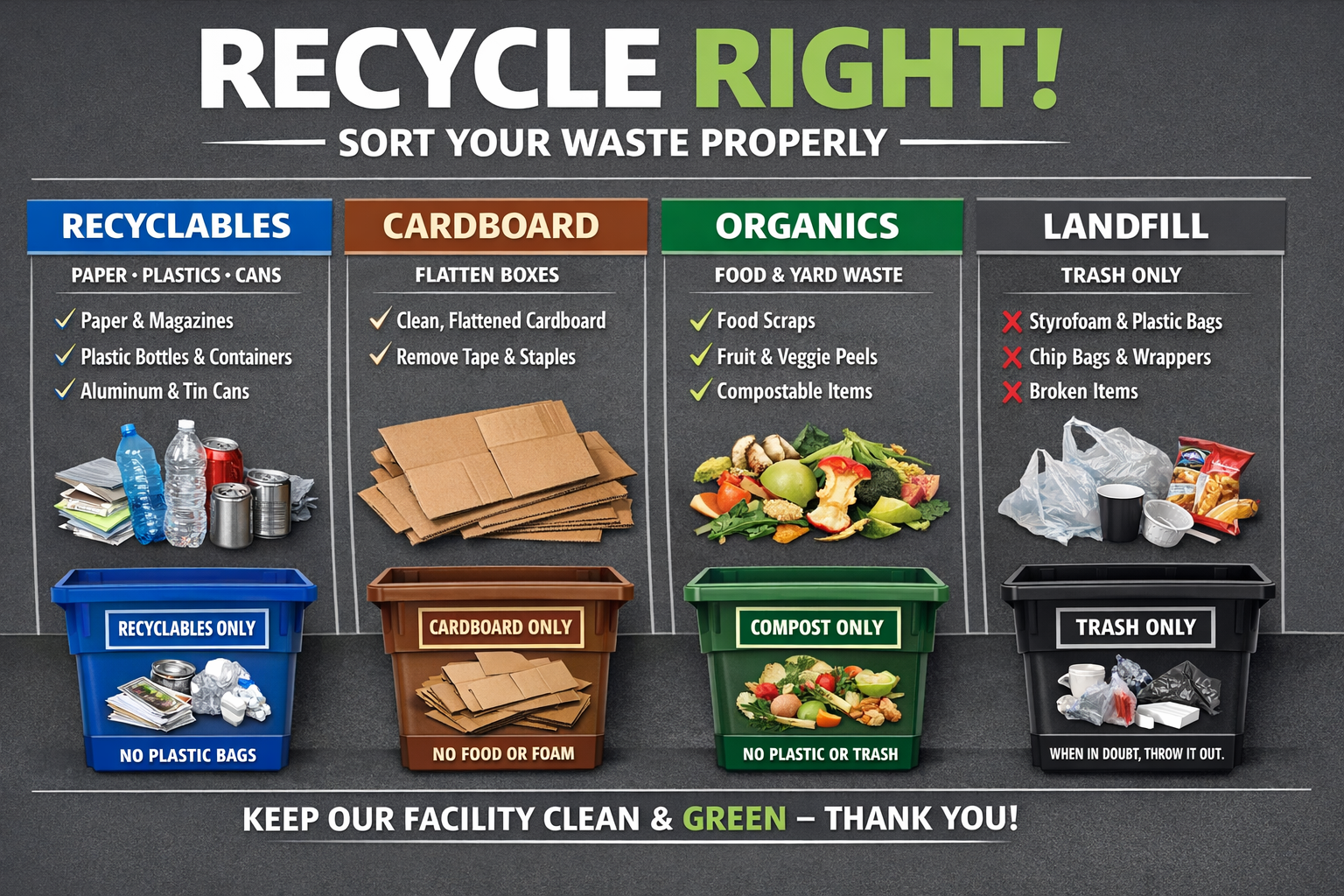
Post permanent reference guides in break rooms and common areas
Send quarterly reminder communications
Conduct periodic refresher walkthroughs
Keeping Participation High Over Time
The programs that last share one characteristic: they don't disappear from attention after the first month.
Share Progress Updates
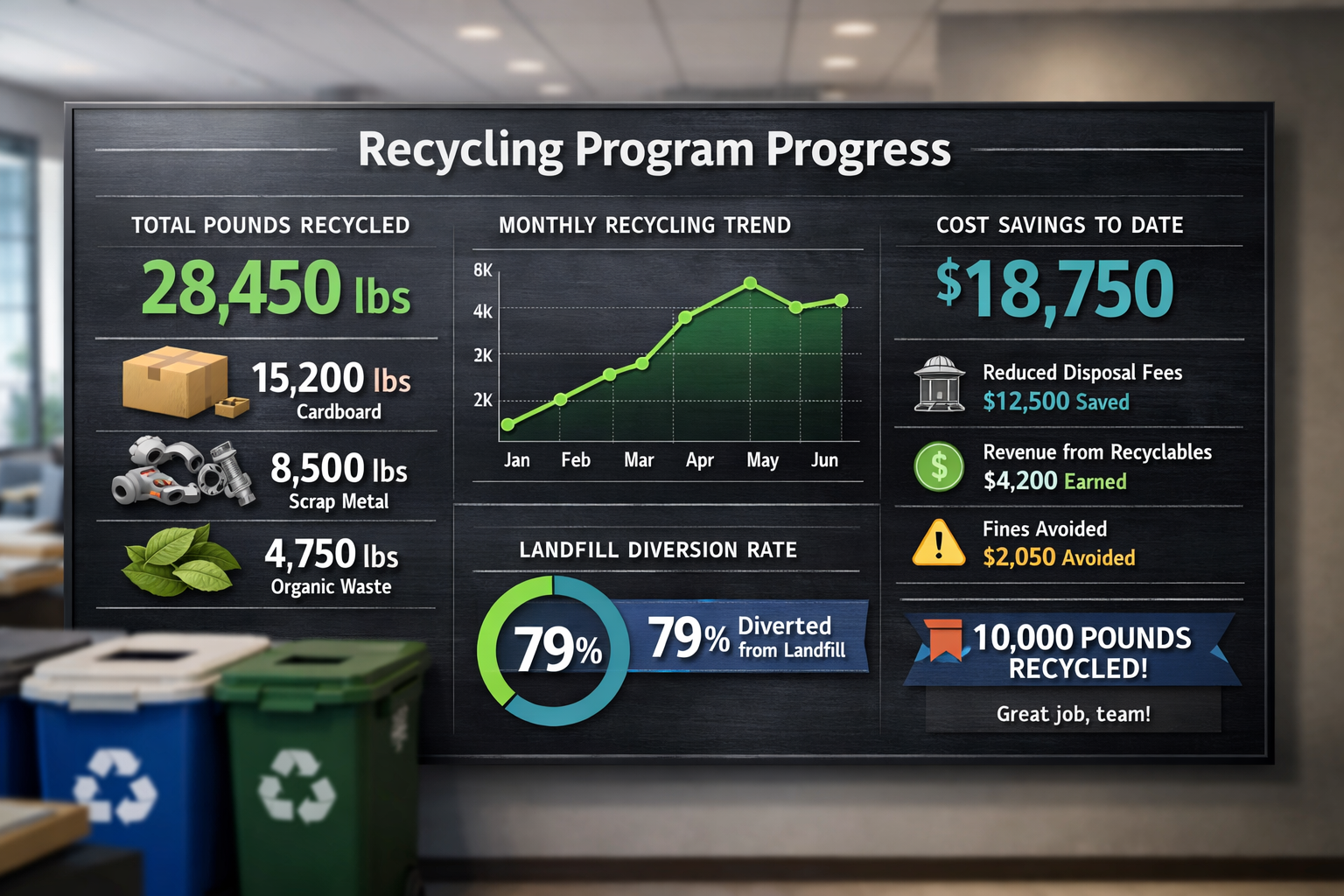
People stay engaged when they see results. Send periodic updates with concrete numbers:
Q3 Recycling UpdateSince launching our recycling program in [month], we've recycled:[X] pounds of cardboard[X] pounds of scrap metal[Total] pounds diverted from landfillThis is equivalent to [relatable comparison—e.g., "the weight of a small car" or "enough cardboard to fill a delivery truck"].Thank you for making this possible. Special recognition to [department/area] for consistently clean recycling bins.
Even rough estimates matter. The point is demonstrating that participation creates real results. Your recycling partner should be able to provide weight documentation from pickups.
Celebrate Milestones
Recognition doesn't require elaborate rewards. Simple acknowledgment works:
Announce when you hit round numbers (1,000 pounds recycled, 6-month anniversary)
Thank specific departments or teams publicly
Post a running total somewhere visible
Recognize individuals who go above and beyond (the person who always flattens everyone's boxes)
Sample milestone announcement:
Subject: We Hit 10,000 Pounds Recycled!This month, our facility crossed 10,000 pounds of recycled materials since we started tracking in [month].That's [X] truckloads of material that didn't go to landfill—and [X] pounds of weight we didn't pay to haul as trash.Thank you to everyone who takes the extra few seconds to use the right bins. It adds up.
Conduct Periodic Reviews
Set calendar reminders to assess your program every quarter:
Are contamination rates acceptable?
Are bins filling at predictable rates?
Have any new waste streams emerged that should be added?
Is your recycling partner meeting pickup schedules reliably?
Do new employees know the procedures?
A 30-minute quarterly review prevents gradual program erosion.
Working with Your Recycling Partner
Your relationship with whoever handles your recyclable materials affects program success. The right partner does more than show up with a truck.
What to Expect from a Good Recycling Partner
A reliable commercial recycling service should provide:
Clear communication about accepted materials so you can train employees accurately
Consistent pickup schedules that match your generation rates
Flexibility for volume changes during busy periods or special projects
Documentation showing what was collected (useful for compliance reporting and progress tracking)
Guidance on preparation so materials arrive in acceptable condition
For facilities generating significant scrap metal or cardboard, on-site pickup services eliminate the burden of transporting materials yourself [4]. Your recycling partner handles the logistics while you focus on internal operations.
Request Periodic Reviews
Ask your recycling partner to periodically review your setup. An experienced eye might spot:
Materials you're throwing away that could be recycled
Preparation practices that could improve material value
Bin placement or sizing improvements
Industry-specific opportunities you hadn't considered
This outside perspective often identifies easy wins that internal staff overlook because they're too close to daily operations.
Educational Support
Some recycling services provide educational materials you can use for employee training—signage templates, quick reference guides, and answers to common questions about what happens to materials after pickup. Take advantage of these resources rather than creating everything from scratch.
The Financial Case: Why This Effort Pays Off
Beyond compliance, a well-run recycling program directly impacts your bottom line:
Reduced disposal costs: General waste disposal is typically charged by weight or volume. Separating heavy materials like metal and dense cardboard from your regular trash stream reduces what you're paying to haul to landfill.
Potential revenue: For valuable materials like copper, aluminum, brass, and clean baled cardboard, you may receive compensation. Market prices fluctuate, but for facilities generating significant volumes, this can offset program costs or even generate income.
Avoided fines: California's recycling mandates include enforcement mechanisms. AB 341 and SB 1383 violations can result in penalties that far exceed the cost of running a proper program.
Operational efficiency: A clean, organized facility with designated waste streams runs more smoothly than one with overflowing dumpsters and materials piling up in corners.
Sustaining Long-Term Success
Recycling programs fail when they become invisible. The facilities that maintain high participation treat recycling as an ongoing operational priority, not a one-time project.
Monthly maintenance checklist:
Walk through bin areas and note any issues
Check that signage is still posted and readable
Confirm pickup schedules are being met
Address any contamination patterns that emerged
Remind new employees of procedures
Quarterly maintenance checklist:
Review overall recycling volumes and trends
Assess whether bin locations and quantities still match needs
Send progress update to employees/tenants
Meet with recycling partner to discuss any concerns
Update training materials if procedures changed
Annual maintenance checklist:
Evaluate whether to add new material streams
Review recycling partner relationship and service quality
Set goals for the coming year
Recognize major contributors
Refresh signage and educational materials
The work never fully ends, but it becomes routine. A well-established recycling program eventually runs on autopilot with only light maintenance.
Ready to Get Your Program Started?
Launching a recycling program takes effort upfront, but the operational benefits compound over time. Cleaner facilities, reduced disposal costs, regulatory compliance, and environmental responsibility all follow from getting employees and tenants engaged from day one.
If your facility generates significant volumes of scrap metal, cardboard, or other recyclable materials, having the right pickup partner makes everything easier. Call Willis Recycling at (916) 271-2691 for a free evaluation of your materials and to discuss scheduling that fits your operation.
Frequently Asked Questions
How long does it take for employees to consistently use recycling bins correctly?
Most facilities see reliable behavior within 4-6 weeks if the program launches with clear training and consistent reinforcement. The first two weeks require the most active monitoring and correction. After that, habits form and participation becomes routine for most people. New employee onboarding and periodic reminders help maintain consistency as your team changes over time.
What's the biggest reason workplace recycling programs fail?
Poor bin placement causes more failures than any other factor. When recycling bins are inconvenient—located far from where waste is generated or harder to access than trash cans—people default to the easier option. Placing recycling bins directly next to trash cans at high-generation points solves most participation problems before they start.
How do we handle tenants who refuse to participate in building recycling programs?
Start with education, as some tenants may not understand expectations or procedures. For persistent non-participation, include recycling requirements in lease renewal discussions and building communications. Some property managers conduct periodic waste audits by tenant area to identify and address problems directly. In California, you can also point to state mandates that apply to commercial tenants.
Should we pay employees for recycling participation?
Financial incentives rarely improve recycling behavior in workplace settings. What works better: making recycling convenient, providing clear instructions, sharing progress results, and having leadership visibly support the program. Recognition and convenience drive participation more effectively than small rewards, which can actually undermine intrinsic motivation.
How often should recycling bins be emptied?
Bins should be emptied before they overflow—overflowing bins discourage participation and create contamination when people force items in or leave materials nearby. Track how quickly bins fill during the first month, then establish a pickup schedule that empties bins when they're approximately 75% full. Adjust seasonally or during high-volume periods like inventory changeovers or construction phases.
About Willis Recycling
Willis Recycling is a family-owned mobile recycling service based in Sacramento, serving businesses throughout Northern California since 2017. With nearly two decades of combined industry experience, the Willis team specializes in on-site scrap metal and cardboard pickup for commercial operations including construction sites, warehouses, auto shops, and healthcare facilities. The company has recycled over 70 tons of metal for Fortune 500 partners and completed rapid-response projects including removing 125 hospital beds for Kaiser Permanente in under 72 hours. Willis Recycling provides ID-verified intake, transparent documentation, and flexible scheduling to help businesses maintain clean, compliant facilities.
Cited Works
[1] U.S. Environmental Protection Agency — "Facts and Figures about Materials, Waste and Recycling." https://www.epa.gov/facts-and-figures-about-materials-waste-and-recycling
[2] Willis Recycling — "Commercial Scrap Metal Pickup Sacramento." https://www.willisrecycling.com/commercial-scrap-metal-pickup-sacramento/
[3] Willis Recycling — "On-Site Scrap & Cardboard Pickup Services."
https://www.willisrecycling.com/cardboard-recycling-for-business/
[4] ScrapMonster — "Willis Recycling Company Profile." https://www.scrapmonster.com/company/willis-recycling/146162