Most businesses sign a contract with a waste hauler and assume the trash problem is solved. The dumpster gets emptied on schedule, the invoice arrives monthly, and nobody thinks much about it until something goes wrong.
But here's what facility managers and operations directors across Sacramento eventually notice: their waste hauler contract wasn't designed to handle everything their business generates. Scrap metal piling up in the back lot. Cardboard bales taking over the loading dock. Old equipment waiting for someone to deal with it.
That's not a failure of your waste hauler. It's a gap that a dedicated recycling partner fills.
Understanding the difference between these two services—and why Northern California businesses benefit from using both—can reduce costs, improve compliance, and turn waste streams into actual value.
What Your Waste Hauler Contract Actually Covers
Waste haulers provide an essential service. They show up on schedule, empty your dumpsters or compactors, and transport general refuse to the appropriate disposal facility. For most businesses, this covers the day-to-day waste that accumulates from normal operations.
A typical commercial waste hauler contract includes:
Scheduled pickup of general trash at agreed intervals (weekly, bi-weekly, or more frequently for high-volume locations)
Container rental for dumpsters, compactors, or roll-off bins
Transport to landfill or transfer station for materials that cannot be recycled
Basic compliance documentation showing waste was disposed of properly
These services keep your facility clean and functional. They handle the organic waste, mixed refuse, and non-recyclable materials that every business generates.
But waste haulers operate on volume. Their business model depends on moving large quantities of material efficiently. That structure means they're not set up to evaluate individual items, separate valuable metals from mixed loads, or provide competitive compensation for recyclable commodities.
What Waste Haulers Typically Do Not Include
The gaps in standard waste contracts often surprise business owners. Materials that seem like obvious candidates for the dumpster actually require different handling—or represent missed opportunities.
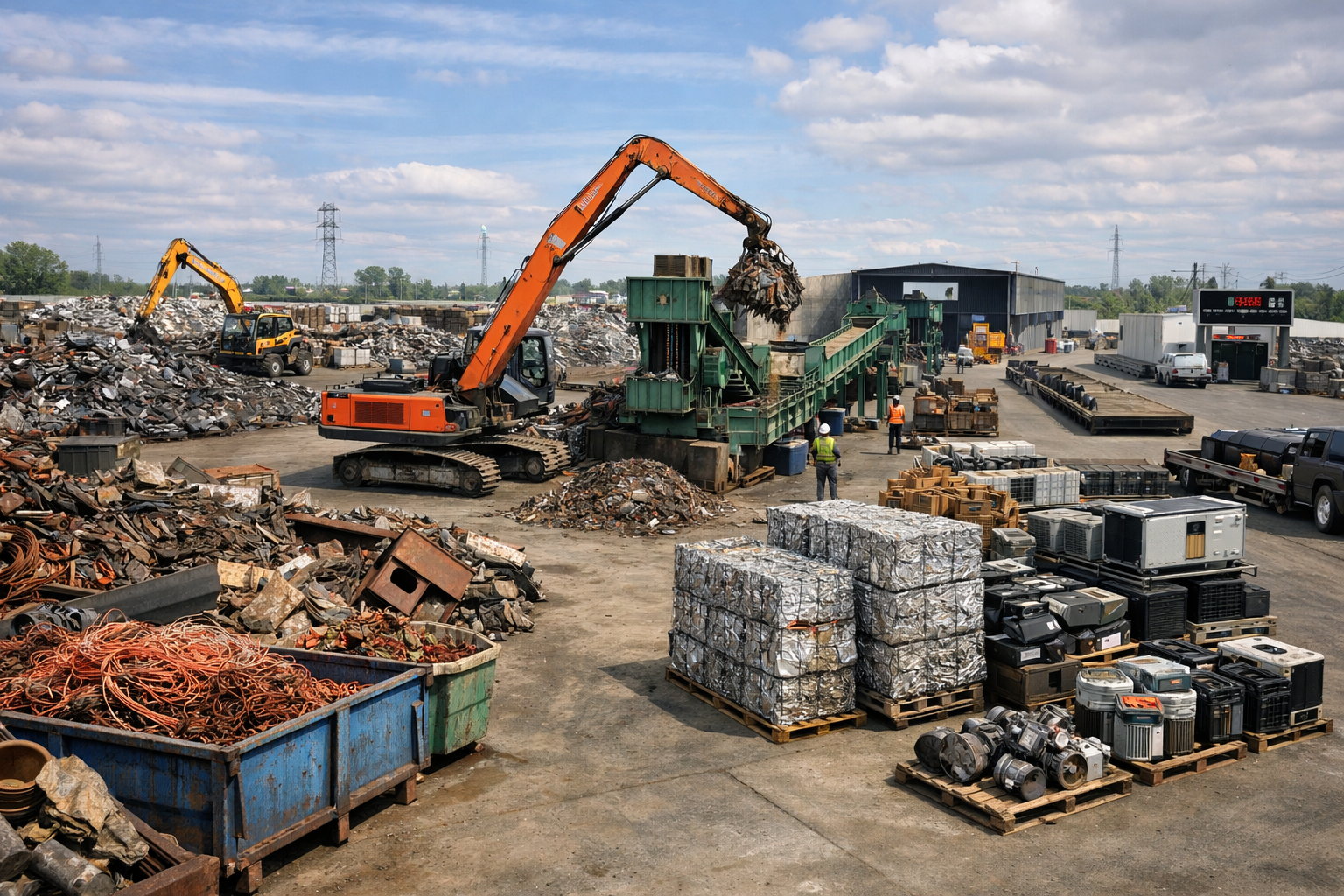
Scrap metal rarely belongs in your regular waste stream. Most hauler contracts either exclude metal entirely or charge premium rates for heavy materials that increase their transport costs. That copper wire, aluminum scrap, or steel offcuts sitting in your facility has real commodity value that disappears the moment it hits a landfill.
Baled cardboard presents a similar issue. While some waste contracts include cardboard pickup, they typically treat it as refuse rather than a recyclable commodity. High-volume cardboard generators—retailers, warehouses, distribution centers—often pay their hauler to remove material that could be handled more cost-effectively through proper recycling channels.
E-waste and equipment fall outside standard waste contracts almost universally. Computers, servers, HVAC units, and industrial equipment require specialized handling due to both their material value and regulatory requirements. California law prohibits certain electronics from landfill disposal entirely.
Construction and demolition debris from renovation projects usually requires separate arrangements. CALGreen regulations in California mandate that at least 65% of construction and demolition waste be diverted from landfills [1]. Meeting this requirement demands documentation that standard waste haulers may not provide.
Why Recyclable Materials Need a Dedicated Partner
The materials your waste hauler doesn't handle well are exactly the ones where a recycling partner adds value. This isn't about finding a replacement for your existing service. It's about adding a specialist who focuses on what general haulers aren't designed to do.
Scrap Metal Requires Evaluation and Sorting
Scrap metal prices vary dramatically based on material type, condition, and current market rates. Copper commands significantly higher prices than steel. Clean aluminum is worth more than painted or contaminated material. Insulated wire requires processing that affects its value.
A waste hauler treats all of this as undifferentiated weight. A recycling partner evaluates each material type, sorts accordingly, and provides compensation based on actual commodity value.
For businesses generating regular scrap—construction contractors, HVAC companies in Roseville, auto shops throughout the Sacramento Valley, hospitals replacing equipment—this difference translates directly to the bottom line.
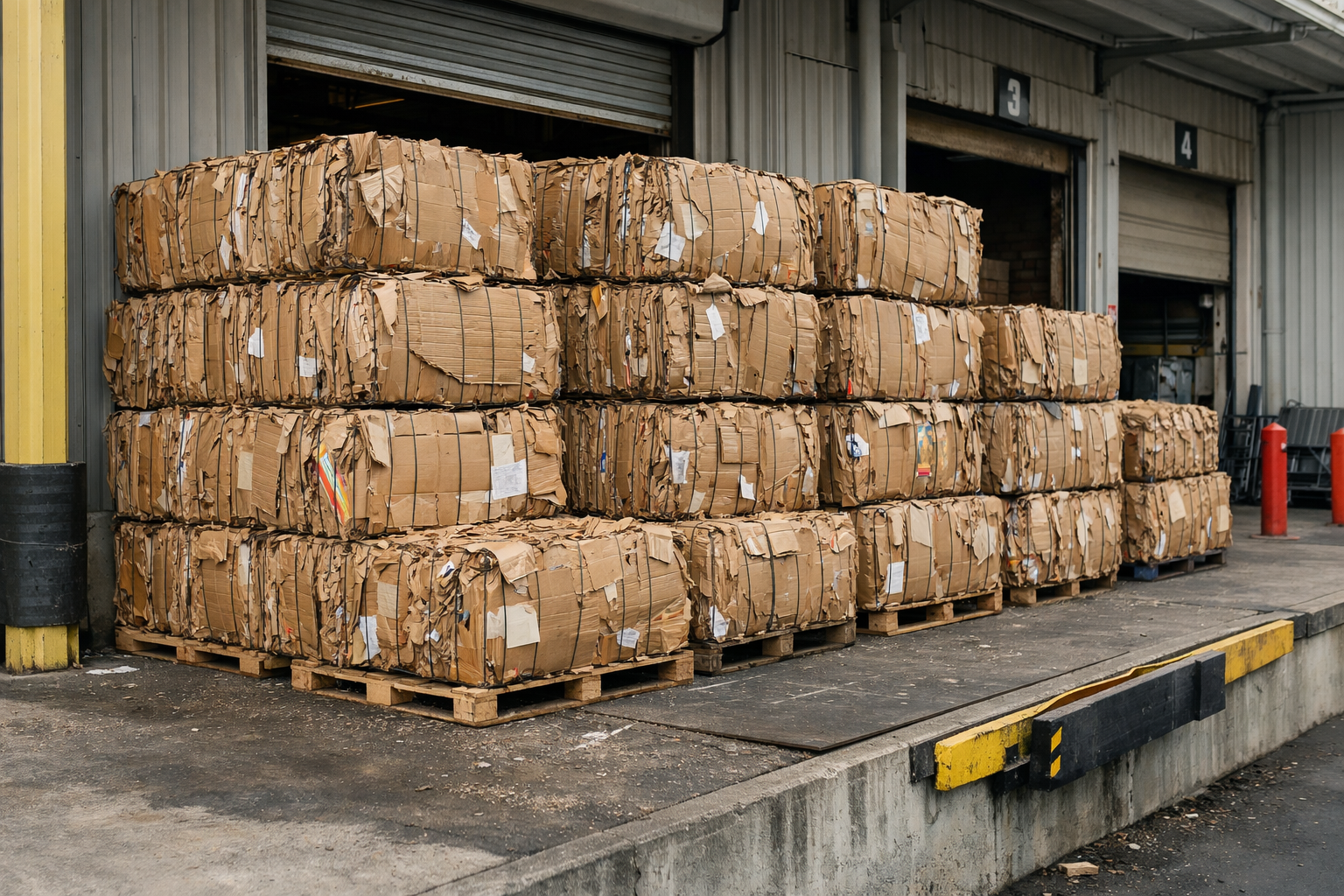
Cardboard Bales Need Volume Handling
Retail operations, warehouses, and distribution centers generate enormous quantities of cardboard. When that material flows through a standard waste contract, the business typically pays for removal.
A dedicated recycling partner approaches baled cardboard differently. While cardboard values fluctuate with market conditions, proper handling through recycling channels removes the material at lower cost than waste disposal—and in favorable market conditions, may generate modest returns.
More importantly, a recycling partner can handle cardboard on a schedule that matches your actual accumulation patterns rather than fixed waste pickup intervals.
E-Waste Demands Specialized Processing
Electronic waste cannot legally go into standard landfills in California. Beyond regulatory requirements, e-waste contains both hazardous components and valuable recoverable materials.
A recycling partner with e-waste capabilities ensures proper handling, provides documentation for compliance purposes, and recovers value from components that would otherwise represent a disposal cost.
For businesses handling computers and servers, data security adds another consideration. Proper e-waste recycling includes verification that storage devices are handled appropriately—a concern that standard waste haulers simply don't address.
Adding a Recycling Partner Does Not Mean Replacing Your Hauler
This is the point where many business owners hesitate. They assume working with a recycling partner means changing their entire waste management approach, renegotiating contracts, or creating operational complexity.
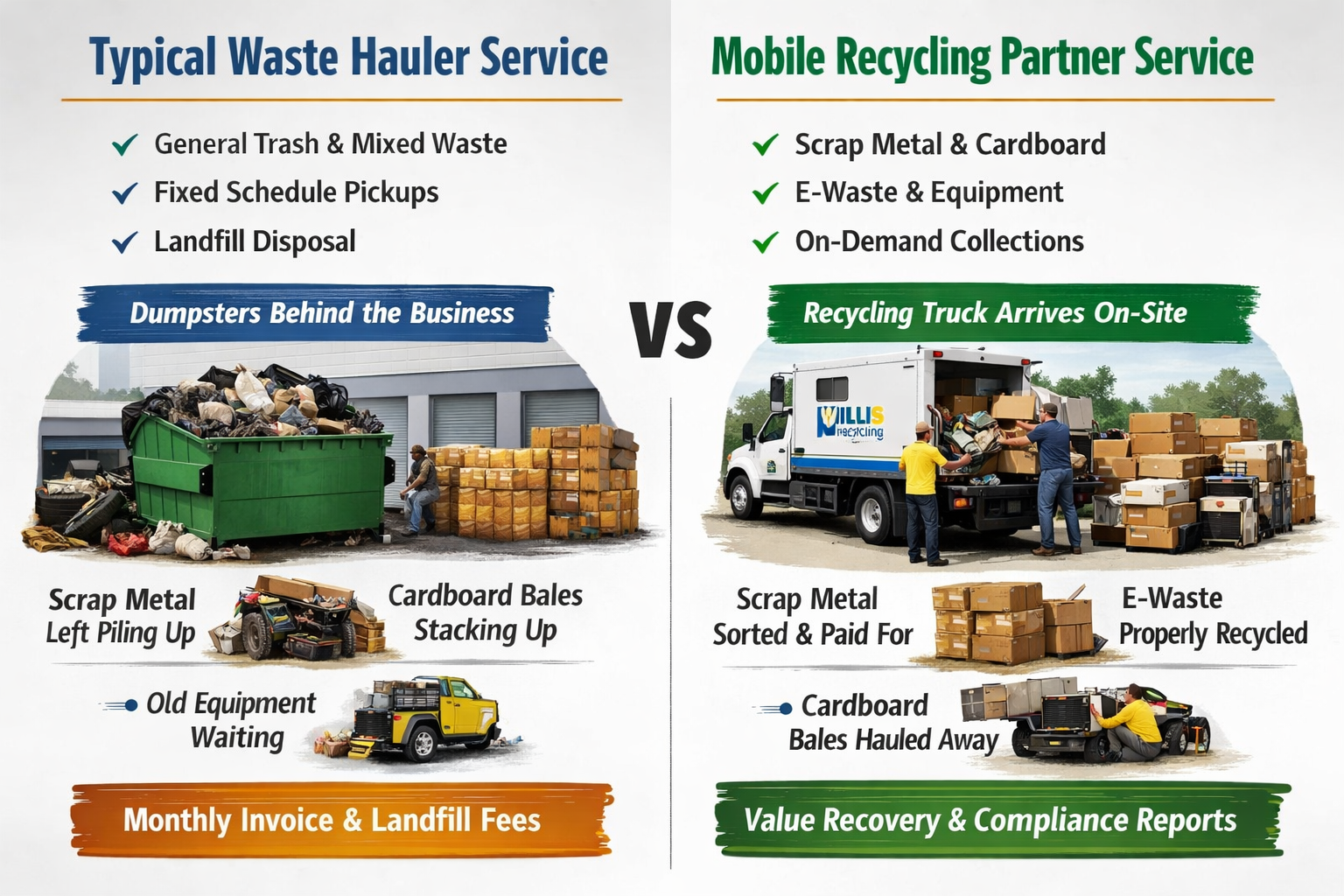
The reality is simpler. Your waste hauler continues doing exactly what they do well—handling general refuse on a predictable schedule. Your recycling partner handles the specific materials that fall outside that scope.
These services complement each other rather than compete.
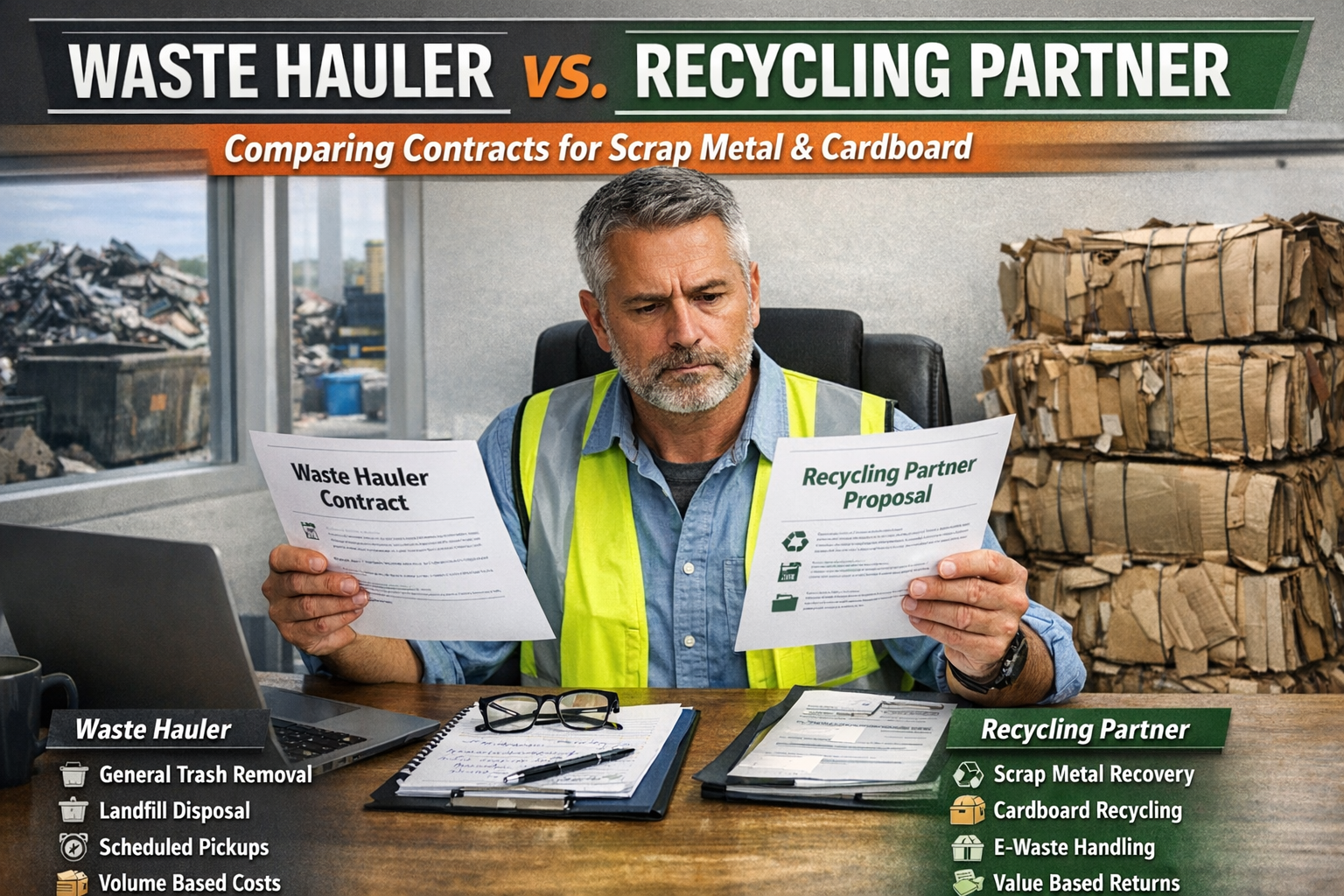
| Service Type | What They Handle | How It Works |
| Waste Hauler | Day-to-day general trash, organic waste, food service refuse, mixed materials with no recovery value | Regular scheduled service with permanent containers on your property |
| Recycling Partner | Scrap metals (copper, brass, aluminum, steel, iron), cardboard bales, e-waste and surplus equipment, HVAC units, construction scrap | On-demand service—accumulate material, then schedule removal when ready |
The operational footprint differs too. Waste haulers provide continuous scheduled service with permanent containers on your property. Recycling partners typically work on an as-needed basis—you accumulate material until you have enough for a pickup, then schedule removal.
For many businesses, this means calling for a recycling pickup monthly, quarterly, or whenever a specific project generates material. The service adapts to your actual waste generation rather than running on a fixed calendar.
The Space Question: How Mobile Recycling Works
One objection we hear frequently: "We don't have room for another dumpster or bin."
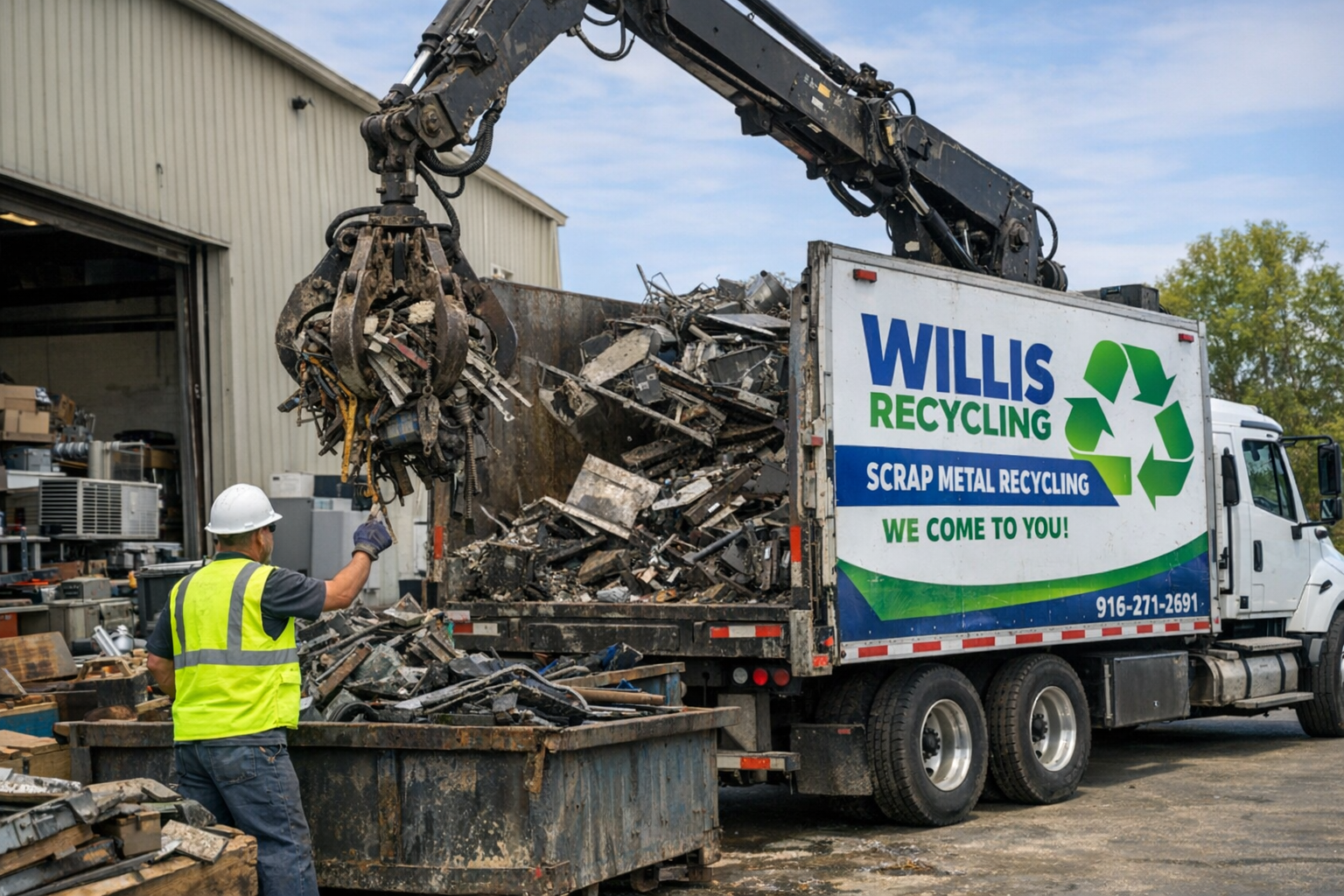
Mobile recycling solves this problem entirely. A service like Willis Recycling operates with live loads—we arrive at your location, evaluate and load materials directly onto our truck, and leave with everything. No additional containers taking up space on your property. No bin sitting there for weeks waiting to fill up.
For facilities with tight loading docks or limited outdoor space, this model actually works better than traditional drop-off recycling. An ag equipment dealer in the Central Valley or an HVAC contractor in Elk Grove doesn't need to dedicate yard space to a scrap bin. They accumulate materials in whatever corner works for their operation, then call when they're ready.
How Combined Services Improve Compliance and Reduce Costs
Using both a waste hauler and a recycling partner isn't just about convenience. The combination produces measurable benefits in two areas that matter to operations managers: regulatory compliance and total waste costs.
Stronger Compliance Documentation
California's environmental regulations require businesses to document proper disposal of many materials. Construction projects must demonstrate CALGreen compliance with specific diversion percentages [1]. E-waste has its own tracking requirements. Industrial facilities may face additional reporting obligations.
A professional recycling partner provides itemized documentation showing exactly what materials were collected, their weights, and how they were processed. This paperwork supports compliance audits, LEED certification efforts, and corporate sustainability reporting.
Willis Recycling, for example, provides ID-verified intake and transparent documentation for every pickup—creating the paper trail that protects your business during inspections or audits [2].
Lower Total Waste Management Costs
The math on combined services often surprises business owners who haven't broken down their waste costs by material type.
Without a recycling partner:
All materials flow through waste hauler contract
Hauler charges by weight or container size
Heavy metals increase disposal costs
Cardboard takes up dumpster space, triggering more frequent pickups or overage charges
No compensation for recyclable commodities
With a recycling partner added:
General refuse goes through waste hauler (smaller volumes, less weight)
Scrap metal generates compensation instead of disposal fees
Cardboard removal reduces dumpster overflow
Equipment disposal handled at cost or with partial recovery
Total waste management spend decreases
The specific numbers depend on what your business generates. A construction contractor with significant metal scrap sees different results than a retailer managing cardboard volume. But the principle holds across industries: separating valuable recyclables from general waste reduces costs on both sides of the equation.
Faster Response for Irregular Needs
Waste hauler contracts work best for predictable, recurring needs. The weekly dumpster pickup handles normal operations reliably.
But businesses also face irregular situations that don't fit scheduled service:
Project cleanouts generating large volumes of scrap in a short period
Equipment replacements requiring removal of old machinery
Facility renovations producing construction debris
Inventory liquidations creating surplus material
A dedicated recycling partner provides flexibility for these situations. Willis Recycling offers same-week scheduling for most requests, with same-day service available when circumstances require rapid response [3]. That flexibility means you're not storing material indefinitely while waiting for your next scheduled waste pickup—or paying premium rates for emergency hauler service.
When Kaiser Permanente needed 125 hospital beds processed within 72 hours, that's the kind of rapid-response capability that made the difference [4]. Your regular waste hauler simply isn't structured for that kind of project.
Materials That Benefit Most from Dedicated Recycling
Not every material warrants a separate recycling relationship. General office waste, food service refuse, and mixed trash belong in your standard waste stream.
But several categories consistently justify working with a recycling specialist:
High-Value Metals
Copper, brass, and aluminum command significant per-pound prices that make proper handling worthwhile. These materials consistently represent recoverable value rather than disposal costs [5].
Businesses generating copper wire (electricians, construction contractors), brass fittings (plumbers, HVAC contractors), or aluminum scrap (manufacturers, fabricators) benefit most directly.
Steel and Iron in Volume
Lower per-pound values mean steel and iron require volume to justify handling. But construction sites, demolition projects, and manufacturing operations regularly generate enough tonnage to make dedicated recycling worthwhile.
Willis Recycling typically works with loads starting around 500 pounds, though we can arrange smaller recurring pickups for established clients with regular accumulation patterns [6].
Baled Cardboard
Retail stores, warehouses, and distribution centers with balers generate the volumes that make cardboard recycling practical. If you're running a baler and paying your waste hauler to remove the output, a recycling conversation is overdue.
Equipment and E-Waste
Old computers, servers, HVAC units, hospital equipment, and industrial machinery all require specialized handling. The combination of material value, regulatory requirements, and sheer weight makes these poor candidates for standard waste contracts.
How to Evaluate Your Current Waste Situation
Before adding a recycling partner, it helps to understand what you're currently generating and how it's being handled.
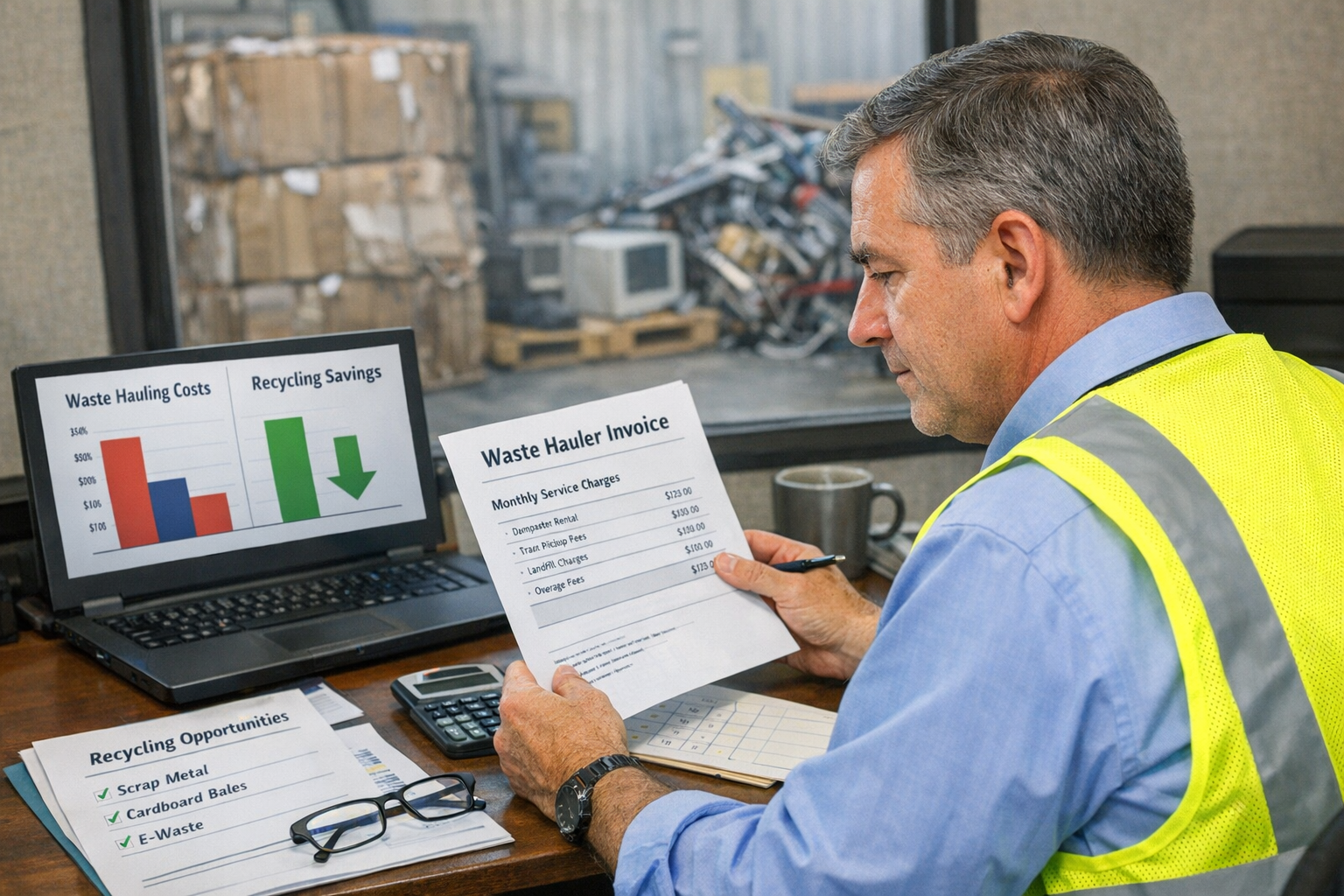
Review Your Hauler Invoice
Your waste hauler invoice contains useful information:
Cost per pickup or per ton reveals your baseline disposal costs
Container size and frequency shows whether you're paying for capacity you don't need
Overage charges indicate materials that don't fit your standard service
Special handling fees may identify recyclable materials being disposed as waste
Assess Your Accumulation Patterns
Walk through your facility with fresh eyes:
Where does scrap metal accumulate?
How quickly does cardboard build up?
What equipment is waiting for disposal?
Are valuable materials ending up in general waste?
Calculate the Opportunity
For each material category, estimate:
Monthly volume in pounds or tons
Current disposal method (waste hauler, self-haul, or sitting in storage)
Current cost (disposal fees, labor for self-hauling, or space consumed)
This assessment doesn't require precision. A rough understanding of what you're generating provides enough information to have a productive conversation with a recycling partner.
What Working with a Recycling Partner Looks Like
The process is simpler than most businesses expect. A mobile recycling service like Willis Recycling handles logistics that would otherwise fall on your team.
Initial Assessment:You describe what materials you have—types, approximate quantities, and location. Photos help. The recycling partner evaluates whether a pickup makes sense and provides preliminary guidance on timing and compensation.
Scheduling:You choose a pickup time that works for your operations. Mobile recycling services come to your location, so you're not pulling staff away to make trips to a recycling center.
On-Site Evaluation:The recycling team arrives with equipment to handle loading and transport. They evaluate materials on-site, providing itemized documentation of what's being collected [7].
Settlement:For valuable materials meeting eligibility requirements, compensation is provided according to current market rates and material type. For other materials, the service removes them at agreed terms—often at lower cost than waste disposal alternatives.
Documentation:You receive paperwork showing materials collected, quantities, and disposition. This supports your compliance records and provides clarity for future planning.
The Bottom Line: Two Services, One Waste Strategy
Your waste hauler handles general refuse efficiently and reliably. That's their job, and most do it well.
But the materials that fall outside standard waste contracts—scrap metal, baled cardboard, e-waste, surplus equipment—need different handling. A dedicated recycling partner fills that gap without disrupting your existing waste management relationship.
The combination improves compliance documentation, reduces total waste costs, and converts materials that would cost you money into materials that return value.
For Sacramento-area businesses generating recyclable materials alongside general waste, the question isn't whether to replace your hauler. It's whether you're leaving money in the dumpster by not adding a recycling partner to your waste strategy.
Ready to see what a recycling partner could do for your business? Willis Recycling offers complimentary reviews of hauler invoices and waste streams for Sacramento-area businesses. Call (916) 271-2691 or email info@willisrecycling.com to schedule a conversation about your specific materials and volumes.
Frequently Asked Questions
Will adding a recycling partner complicate my waste management?
No. Your waste hauler continues handling general trash on their existing schedule. The recycling partner handles specific materials separately, typically on an as-needed basis when you've accumulated enough for a pickup. Most businesses find the arrangement simplifies waste management by giving each material type an appropriate outlet rather than forcing everything through one contract.
What if I don't generate enough scrap to justify a pickup?
Many recycling partners accommodate smaller volumes for established clients with regular accumulation patterns. Willis Recycling typically works with loads starting around 500 pounds but can arrange smaller recurring pickups for ongoing relationships [6]. The initial conversation helps determine what makes sense for your specific situation and accumulation rate.
How do I know which materials belong with my hauler versus a recycler?
General office waste, food refuse, and mixed trash belong in your standard waste stream. Scrap metals, baled cardboard, e-waste, and surplus equipment typically benefit from dedicated recycling. If you're unsure about specific materials, a recycling partner can advise on the best handling approach—and if something's not in their scope, they'll tell you directly.
Does recycling actually save money, or is it just better for the environment?
Both. Diverting heavy metals from your waste stream reduces hauler charges based on weight. Compensation for valuable materials like copper and aluminum creates direct returns. Proper cardboard handling frees dumpster capacity, potentially reducing pickup frequency or overage fees. The environmental benefits are real, but the financial case often stands on its own.
What documentation will I receive for compliance purposes?
Professional recycling partners provide itemized documentation showing materials collected, weights, and processing methods. Willis Recycling includes ID-verified intake and transparent itemization that supports CALGreen compliance, corporate sustainability reporting, and regulatory audits [2].
About Willis Recycling
Willis Recycling is a family-owned mobile recycling service with nearly two decades of industry experience, serving businesses throughout the Sacramento region and Northern California. Our team provides on-site scrap metal and cardboard pickup with transparent evaluation, professional handling, and documentation that supports compliance requirements. We've partnered with Fortune 500 companies, construction firms, healthcare facilities, and local businesses to turn recyclable waste into value while keeping operations running smoothly.
Works Cited
[1] Recology — "Construction and Demolition Recycling Requirements." https://www.recology.com/wp-content/uploads/2018/04/constructionanddemolition.pdf
[2] Willis Recycling — "Homepage: ID-Verified Intake and Documentation." https://www.willisrecycling.com/
[3] Willis Recycling — "Commercial Scrap Metal Pickup Sacramento: Scheduling." https://www.willisrecycling.com/commercial-scrap-metal-pickup-sacramento/
[4] Willis Recycling — "Homepage: Kaiser Permanente Project." https://www.willisrecycling.com/
[5] Institute of Scrap Recycling Industries — "The Scrap Recycling Industry." https://www.isri.org/recycling-commodities
[6] Willis Recycling — "Commercial Scrap Metal Pickup Sacramento: Minimum Requirements."
https://www.willisrecycling.com/commercial-scrap-metal-pickup-sacramento/