Your customers are paying attention to what you throw away.
Business recycling has become more than an operational checkbox. It now directly influences how customers perceive your company, whether they trust your claims, and ultimately, whether they choose you over a competitor. The connection between responsible waste management and brand reputation has grown stronger each year as consumers demand proof behind sustainability promises.
For Sacramento-area businesses generating significant recyclable waste, this creates a genuine opportunity. Your existing recycling efforts—properly communicated—can strengthen customer relationships and differentiate your brand in meaningful ways.
Why Recycling Performance Matters to Your Customers
Consumer expectations around environmental responsibility have shifted dramatically. According to research from IBM and the National Retail Federation, nearly 80 percent of consumers indicate that sustainability is important to them [1]. This isn't limited to retail shoppers. B2B buyers increasingly evaluate vendors based on environmental practices, particularly in industries like construction, healthcare, and logistics where waste volumes are substantial.
The reason is straightforward. Customers view recycling behavior as a signal of broader company values. A business that responsibly manages its scrap metal, cardboard, and e-waste demonstrates operational discipline, community awareness, and long-term thinking. These qualities translate directly to trust.
For facilities managers, operations directors, and business owners in Northern California, this means the tons of copper wire, aluminum, and cardboard bales leaving your facility each month represent more than cost recovery. They represent brand-building opportunities hiding in plain sight.
Concrete Metrics That Build Credibility
Vague environmental claims no longer resonate. Phrases like "committed to sustainability" or "eco-friendly practices" have become background noise. What customers respond to now is specificity.
Consider the difference between these two statements:
"We're dedicated to reducing our environmental footprint."
"Last year, our facility recycled 47 tons of scrap metal, diverting it from landfills and conserving the energy equivalent of powering 23 homes for a year."
The second statement tells a story through numbers. It's verifiable, concrete, and memorable.
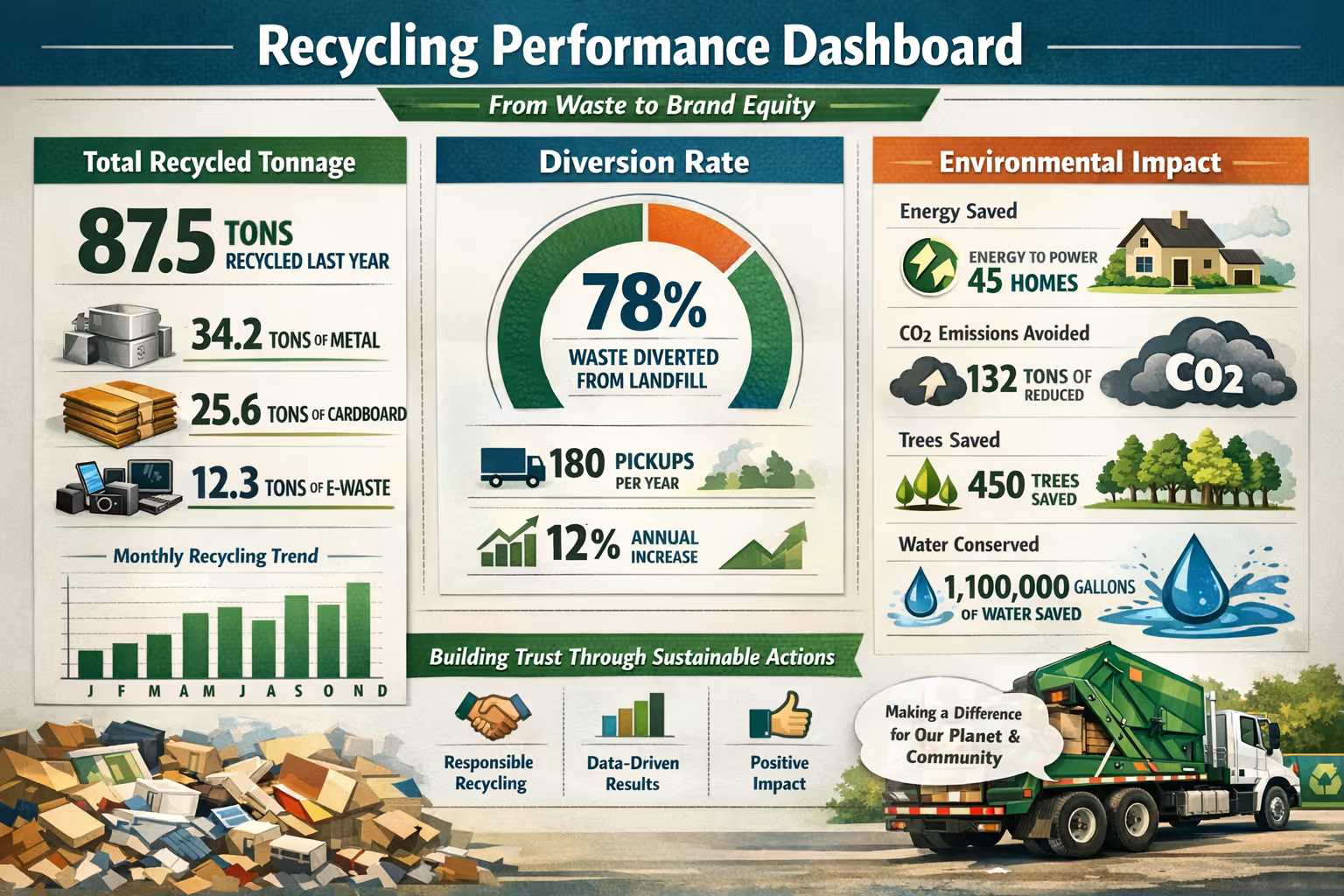
Here are metrics Sacramento businesses can track and share:
Weight-based measurements
Total tons of metal recycled annually
Pounds of cardboard diverted from landfill each month
Percentage of waste stream that goes to recycling versus disposal
Environmental impact equivalents
Energy saved through recycling (aluminum recycling saves 95 percent of the energy needed for new production) [2]
Carbon emissions avoided
Trees saved through cardboard recycling (EPA estimates that recycling one ton of cardboard saves approximately 17 trees) [3]
Operational indicators
Number of pickups completed per quarter
Consistency of recycling program participation
Year-over-year improvement in diversion rates
These numbers transform abstract commitment into tangible proof. When a construction company can state they've recycled 70 tons of metal in a single year, that figure carries weight with clients evaluating their environmental compliance and values alignment.
How to Share Your Recycling Story Without Overclaiming
The fastest way to damage credibility is making environmental promises you cannot substantiate. Greenwashing—exaggerating or fabricating sustainability credentials—has become a significant reputational risk as both consumers and regulators grow more sophisticated.
Effective recycling communication follows several principles.
Stick to what you can document. If your recycling partner provides weight tickets and itemized receipts, use those figures. Avoid estimating or rounding up dramatically. A statement like "We recycled approximately 12,000 pounds of copper last quarter" is defensible. "We save the planet every day" is not.
Focus on actions, not aspirations. Describe what you actually do rather than what you hope to achieve. "Our warehouse schedules monthly cardboard bale pickups" is stronger than "We're working toward zero waste."
Provide context for numbers. Raw tonnage means little to most audiences. Translate figures into relatable terms. Explain what 10 tons of recycled steel represents in terms of energy savings or emissions reduction.
Acknowledge limitations honestly. No business recycles everything perfectly. Mentioning that you're continuously improving your program or working to add new material streams shows authenticity.
Integrate naturally. Environmental messaging works best when woven into broader company communications rather than presented as stand-alone boasting. Include recycling statistics in annual reports, facility tours, customer presentations, and project documentation.
Weaving Recycling Into Your Marketing Campaigns
The most effective recycling communications don't feel like marketing at all. They emerge organically from your operations and customer interactions.
Project documentation and proposalsFor construction firms and contractors, include recycling data in project closeout reports. Document the weight of materials diverted from landfill and highlight compliance with CALGreen requirements. This demonstrates professionalism while building your environmental track record.
Website content and case studiesDevelop a dedicated sustainability page that includes specific metrics, updated quarterly or annually. Feature brief case studies showing how recycling fits into your operations. A hospital facilities team might describe how they managed an equipment replacement project, including proper recycling of 125 hospital beds handled quickly and responsibly.
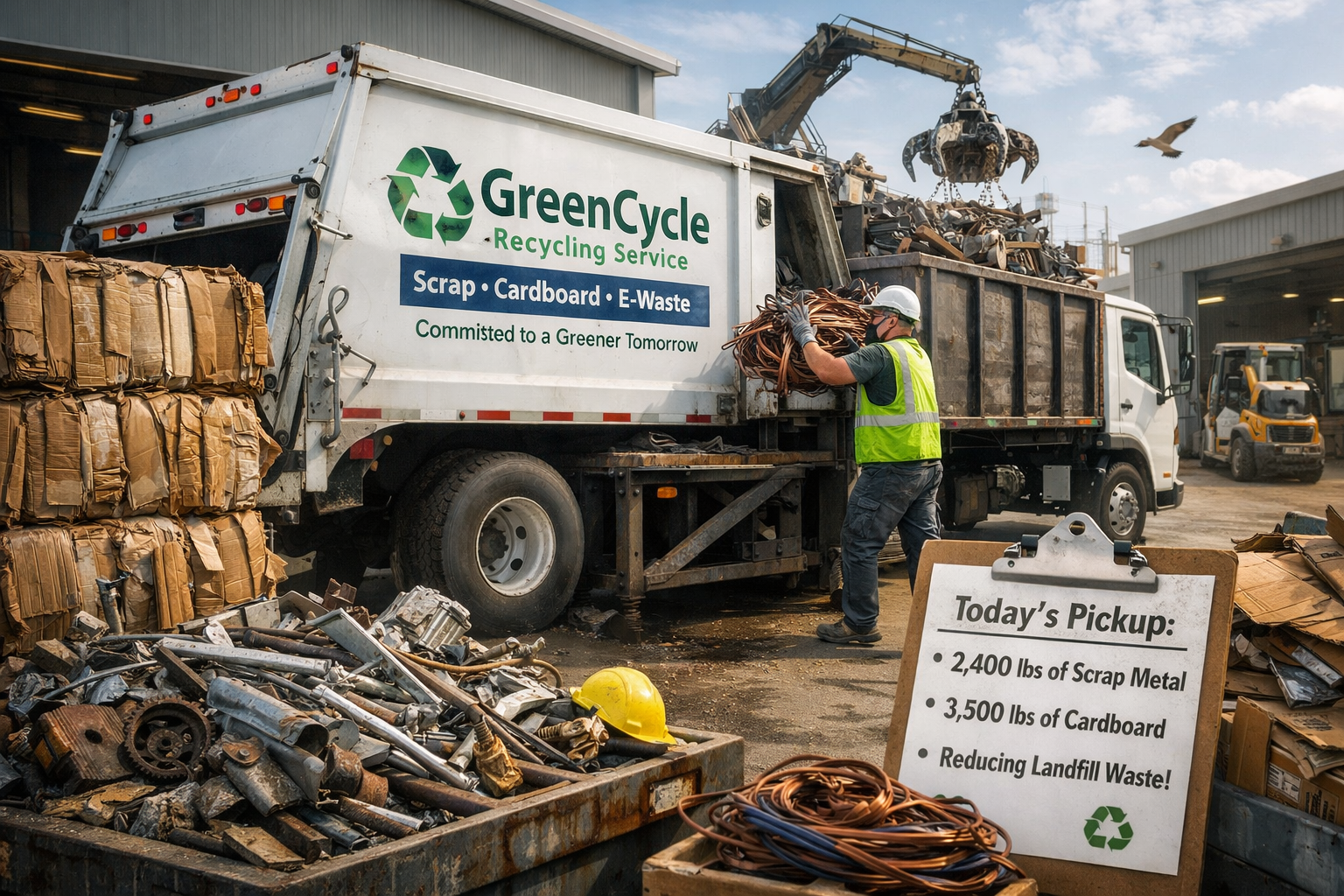
Social media updatesShare photos from pickup days with context. A simple post showing a loaded truck with "Today we sent 3,200 pounds of aluminum to be recycled instead of landfilled" performs better than generic environmental messaging.
Customer communicationsInclude recycling metrics in newsletters or quarterly updates to clients. Frame it as transparency about your operations rather than self-promotion.
Employee engagementInternal communications about recycling program results build culture while creating content that can extend to external channels. Employees who understand and participate in recycling efforts become authentic advocates.
Building Joint Content With Your Recycling Partner
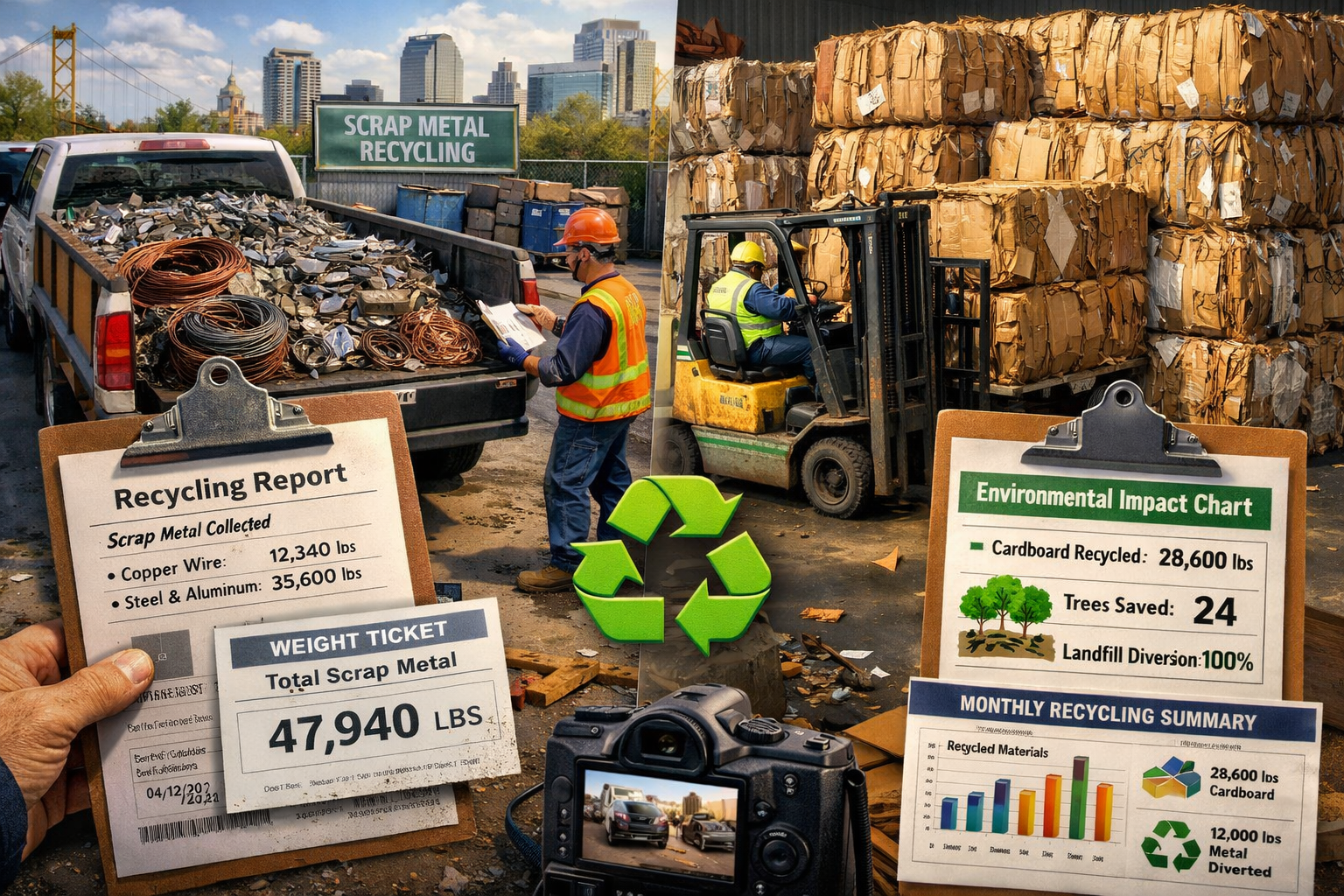
Your commercial recycling service provider holds valuable information that can fuel your marketing efforts. Weight tickets, material breakdowns, and collection records all translate into shareable content.
Consider requesting:
A simple impact summary. Ask your recycling partner to provide a quarterly or annual summary of materials collected from your facility. This document becomes the foundation for multiple content pieces.
Material-specific breakdowns. Understanding exactly what you recycle—copper wire, brass fixtures, aluminum, steel, cardboard bales—allows for more specific and credible communications.
Environmental equivalency calculations. Some recycling services can translate your tonnage into energy savings or emissions reductions, providing the narrative hook that makes numbers memorable.
Process documentation. Understanding where your materials go after pickup—whether to local processors or specific recycling facilities—adds transparency to your sustainability claims.
Joint case studies. If you've completed a significant project with notable recycling volume, collaborate with your recycling partner on a case study that both parties can share. This extends reach while adding third-party credibility.
For example, a Fortune 500 company working with a commercial recycling service might highlight that their partnership resulted in over 70 tons of metal recycled in a single year. That specific, verified figure carries far more weight than vague environmental promises.
From Waste to Brand Equity: The Broader Opportunity
The connection between recycling performance and brand perception extends beyond individual campaigns. Companies that consistently demonstrate responsible waste management build cumulative trust that influences customer decisions.
Customer retention. Existing clients who see your environmental commitment in action develop stronger loyalty. This matters particularly in B2B relationships where vendor switching costs are high.
Competitive differentiation. When proposals and bids include documented recycling practices, you stand apart from competitors making only generic claims.
Employee recruitment. Younger workers increasingly evaluate employers on environmental responsibility. Visible recycling programs signal company values to prospective hires.
Regulatory compliance. California's environmental requirements, including CALGreen construction waste diversion mandates, mean recycling documentation serves both marketing and compliance purposes simultaneously.
Community reputation. Local businesses that visibly contribute to sustainability goals build goodwill that extends beyond direct customer relationships.
The investment required is modest. You're likely already recycling significant materials. The opportunity lies in documenting, measuring, and communicating those efforts strategically.
Getting Started: Practical Next Steps
Transforming your recycling operations into brand-building content doesn't require a complete marketing overhaul. Start with these straightforward steps.
Audit your current recycling. What materials are you sending for recycling? How much weight moves through your facility monthly? Establish baseline metrics.
Request documentation from your recycling partner. Weight tickets, itemized receipts, and collection summaries provide the raw material for credible communications.
Calculate environmental impact. Use established conversion factors to translate tonnage into energy savings, emissions reduction, or resource conservation.
Identify communication channels. Where can recycling information fit naturally into your existing customer touchpoints? Proposals, reports, websites, and social media all offer opportunities.
Commit to consistency. Update your metrics quarterly or annually. Building credibility requires sustained effort, not one-time announcements.
The businesses that benefit most from recycling-based marketing aren't those with the largest programs. They're the ones that communicate authentically, provide specific evidence, and integrate sustainability into their broader brand story.
Ready to strengthen your recycling program and build the documentation that supports credible marketing? Contact Willis Recycling at (916) 271-2691 for a free evaluation of your materials and a summary of your recycling impact.
Frequently Asked Questions
What specific recycling metrics should businesses track for marketing purposes?Focus on weight-based measurements like total tons recycled annually, pounds of specific materials (copper, aluminum, cardboard) diverted monthly, and your facility's overall diversion rate. Translate these into environmental equivalents—energy saved, emissions avoided, or resources conserved—to make numbers meaningful for audiences unfamiliar with recycling operations.
How do I avoid greenwashing accusations when promoting our recycling efforts?Stick to documented, verifiable claims based on weight tickets and collection records from your recycling partner. Describe actual practices rather than aspirations, provide context for numbers, and acknowledge areas where you're still improving. Avoid vague phrases like "eco-friendly" in favor of specific statements like "We recycled 15 tons of scrap metal last quarter."
Can small recycling programs still provide meaningful marketing content?Absolutely. Authenticity matters more than scale. A business recycling 500 pounds of copper monthly can still share that story credibly. Focus on consistency, year-over-year improvement, and the specific actions you take. Small programs communicated honestly often resonate more than large programs described vaguely.
How often should we update our recycling metrics in marketing materials?Quarterly updates work well for social media and internal communications. Annual summaries are appropriate for website content, case studies, and formal reports. The key is establishing a regular cadence that shows ongoing commitment rather than one-time effort.
What should I ask my recycling partner to provide for marketing content?Request a simple impact summary showing total weight by material type, pickup frequency, and if available, environmental impact calculations. Ask about the destination of your materials and whether they can provide any third-party verification or certifications that add credibility to your claims.
About Willis Recycling
Willis Recycling is a family-owned mobile recycling service with nearly two decades of industry experience serving Sacramento and Northern California. We provide on-site scrap metal and cardboard pickup for businesses, handling everything from collection to documentation so you can focus on your operations. Our team works with construction firms, healthcare facilities, retail warehouses, and auto shops throughout the region, providing the transparent documentation that supports both compliance and marketing goals.
Works Cited
[1] IBM and National Retail Federation — "Consumers want it all: Hybrid shopping, sustainability, and purpose-driven brands." https://www.ibm.com/thought-leadership/institute-business-value/en-us/report/2022-consumer-study
[2] U.S. Environmental Protection Agency — "Aluminum." https://www.epa.gov/recycle/recycling-basics-and-benefits
[3] U.S. Environmental Protection Agency — "Paper and Paperboard: Material-Specific Data." https://www.epa.gov/facts-and-figures-about-materials-waste-and-recycling/paper-and-paperboard-material-specific-data