Sacramento's industrial economy runs on construction cranes, warehouse expansions, and the steady hum of auto shops and manufacturing facilities across the region. If you manage a business that generates scrap metal, you already know the market doesn't sit still. Prices move. Demand shifts. And what happens at ports overseas can show up at your loading dock faster than you'd expect.
This Sacramento scrap recycling market outlook covers where metal prices stand today, what's pushing them in different directions, and how to approach your recyclable materials over the coming months.
Current Metal Price Conditions in Northern California
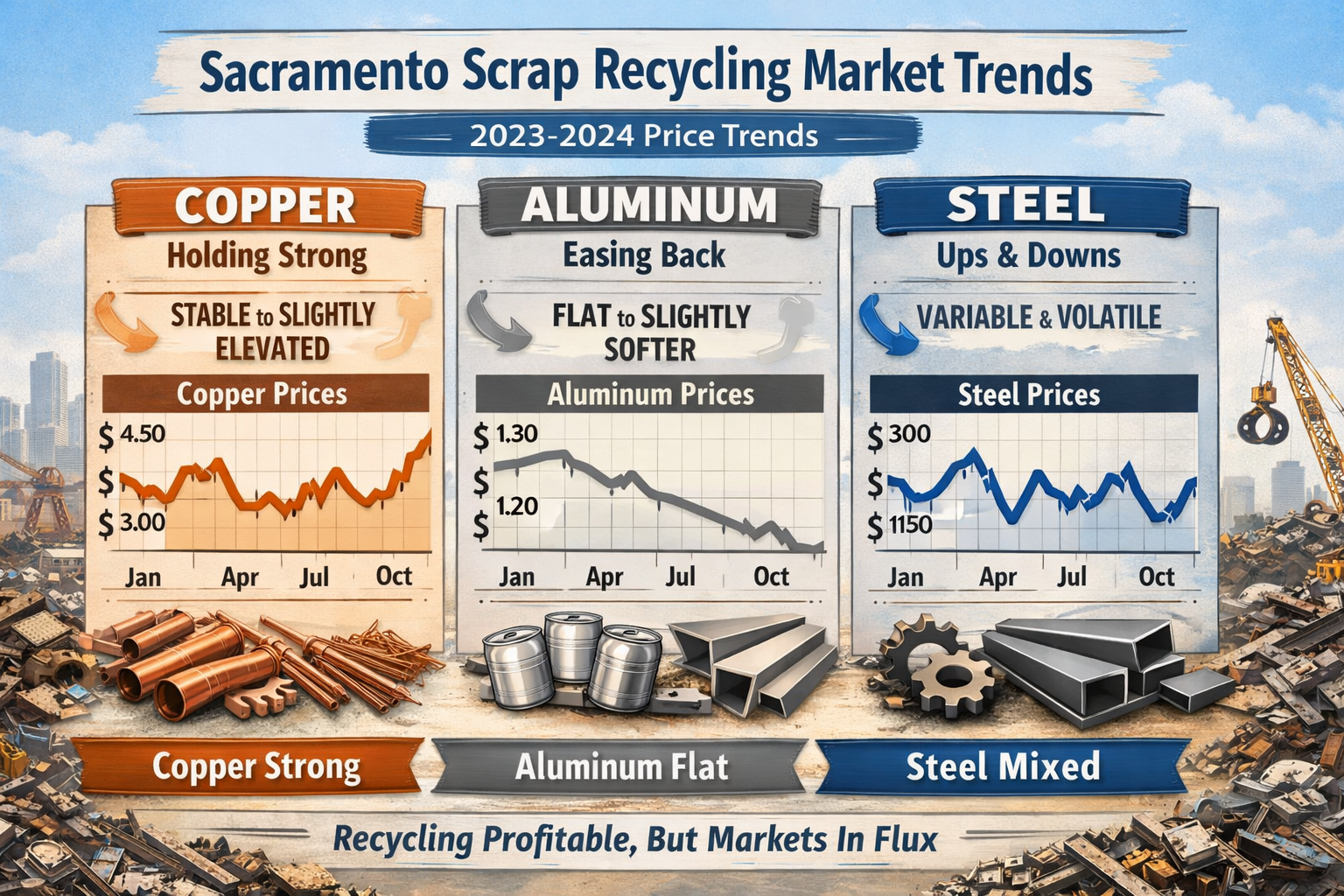
Metal pricing across the Sacramento region has seen notable movement over the past year. Here's where things stand with the most common commercial materials:
Copper: Holding Strong
Copper remains the highest-value metal coming through recycling yards. Prices have stayed relatively firm compared to historical averages, though month-to-month swings are normal.
Current trend: Stable to slightly elevated
Clean copper wire and pipe continue to command the best rates. Insulated wire and mixed copper grades follow at lower price points, as expected. The ongoing push for electrical infrastructure and clean energy projects keeps baseline demand healthy [1].
Aluminum: Softening from Recent Highs
Aluminum pricing has pulled back slightly from peaks seen earlier, though rates remain reasonable for businesses recycling significant volumes.
Current trend: Moderate, trending flat
Clean aluminum—including cans, sheet metal, and extrusions—fetches better prices than painted or contaminated materials. Sorting clean aluminum from mixed loads makes a noticeable difference in returns [2].
Steel and Iron: Variable
Ferrous metals have shown more fluctuation than non-ferrous counterparts. Heavy melting steel and structural steel pricing depends heavily on mill demand, which has varied based on regional construction activity and manufacturing output.
Current trend: Mixed, with regional variation
Sacramento-area steel prices track with West Coast mill activity. Periods of strong construction spending tend to support prices, while manufacturing slowdowns can soften them [3].
Brass: Steady Demand
Brass maintains consistent interest, particularly from plumbing and manufacturing sectors. Mixed brass and clean yellow brass continue to move well at recycling facilities.
Current trend: Stable
The bottom line: prices aren't at their peaks, but they're far from their lows. Most metals remain in ranges where recycling makes clear financial sense for businesses generating significant volumes.
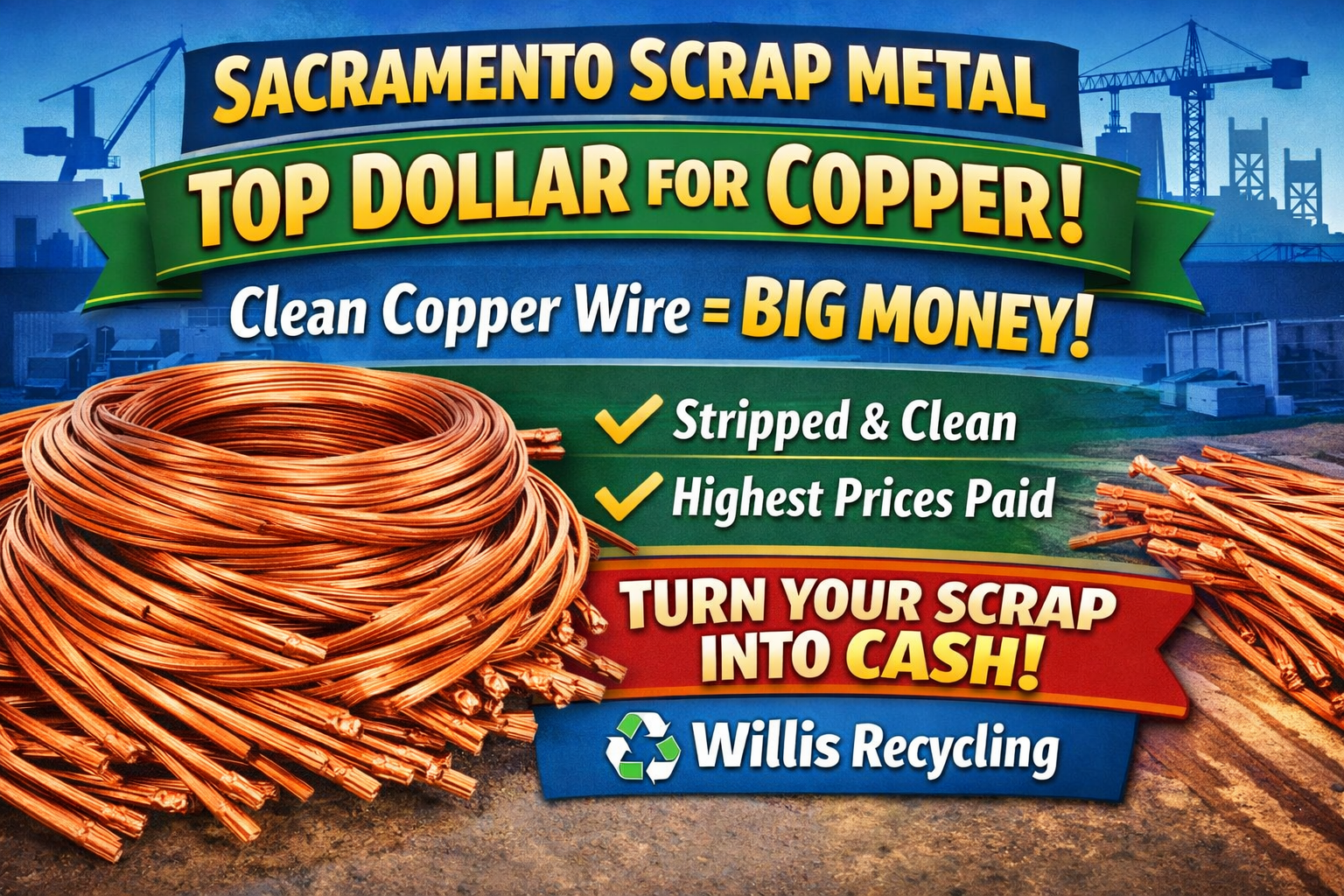
Material of the Quarter: Copper Wire
Copper wire deserves special attention right now. Between EV charging station buildouts, solar installations across the Central Valley, and general electrical work tied to Sacramento's ongoing development, demand for recycled copper feedstock remains strong.
If your business generates electrical wire—whether from construction, demolition, or equipment upgrades—copper represents your highest-value recyclable. Clean, stripped wire commands premium rates. Insulated wire still holds value, and professional recyclers handle the separation.
For construction contractors and electricians in the Sacramento area, copper wire recycling offers meaningful returns rather than just waste removal. Given current demand, now represents a solid window for moving accumulated copper [1].
What's Driving the Sacramento Scrap Recycling Market
Several factors are shaping metal pricing in Northern California and beyond. Understanding these drivers helps explain price movements and provides context for what might happen next.
Regional Construction and Infrastructure Projects
Construction activity directly impacts scrap demand. When builders are busy, they consume more raw materials, which pulls recycled metals into production streams.
Sacramento's development pipeline remains active. The ongoing work at the Railyards mixed-use development downtown continues generating demand. Aggie Square—the UC Davis innovation hub under construction in Sacramento—represents another significant project. Warehouse and distribution center development in Elk Grove, Roseville, and along the I-80 corridor adds to the regional activity [4].
Federal infrastructure spending is flowing into California projects. Road work, bridge repairs, transit upgrades, and utility modernization all consume recycled steel, copper, and aluminum while also generating scrap from demolition and renovation phases [5].
Electric Vehicle and Clean Energy Expansion
The shift toward electric vehicles and renewable energy infrastructure is increasing demand for certain metals, particularly copper and aluminum.
California leads EV adoption, and Sacramento serves as a hub for charging infrastructure deployment. Each charging station requires significant copper wiring. Solar installations across the Central Valley consume aluminum for framing and copper for electrical systems [10].
This transition creates sustained demand for recycled materials. While day-to-day pricing still responds to broader economic conditions, the underlying demand trend supports these metals over the longer term.
Global Supply Chain Factors
What happens overseas affects Sacramento scrap prices. China remains a major consumer of recycled metals globally, and shifts in their manufacturing output influence commodity markets.
When Chinese demand runs strong, it tends to support prices. When their economy slows or they restrict certain imports, domestic prices can soften [6].
Shipping costs and logistics also play a role. Supply chain disruptions—whether from port congestion, labor issues, or geopolitical tensions—create temporary price swings as material flows get disrupted.
Energy Costs and Production Economics
Producing new metal from ore requires substantial energy. When energy prices rise, recycled materials become comparatively more attractive to mills and foundries, which supports scrap pricing.
Recycling aluminum, for example, uses roughly 95 percent less energy than producing primary aluminum from bauxite. This energy advantage makes recycled feedstock economically attractive when electricity and natural gas costs climb [7].
Domestic Manufacturing Trends
Reshoring initiatives and domestic manufacturing incentives have gradually increased demand for raw materials in the United States. As more production returns stateside, demand for feedstock—including scrap metals—follows [8].
Should You Move Scrap Now or Wait?
This question comes up in nearly every conversation with Sacramento-area businesses: should we hold onto scrap waiting for better prices, or move it now?
Here's the straightforward answer based on what we see across hundreds of commercial accounts.
Why Consistent Recycling Usually Wins
For most businesses, regular recycling beats attempting to time the market. Several practical reasons drive this:
Storage costs add up. Scrap sitting in your yard, warehouse, or loading dock takes up space you could use for operations. That space has real value. Equipment, materials, and workflow all compete for room.
Market timing is difficult. Professional commodities traders with dedicated research teams struggle to predict short-term price movements accurately. For a business focused on construction, manufacturing, or retail, trying to speculate on scrap markets diverts attention from core operations.
Regular pickups maintain workflow. Scheduling consistent scrap removal keeps your site clean, reduces safety hazards, and ensures compliance with waste management requirements. Cluttered job sites slow down work and create liability.
Cash flow matters more than marginal gains. Getting paid for your scrap today—even if prices rise slightly next month—puts money in your budget now. That liquidity often matters more than chasing a few extra cents per pound.
When Waiting Might Make Sense
There are limited situations where holding material could be reasonable:
You have secure, low-cost storage and the scrap isn't creating operational problems
You're sitting on a large volume of high-value materials like clean copper during a notably depressed market
You have reliable insight (from a trusted recycling partner) suggesting significant near-term price improvements
Even in these cases, the gains from waiting need to outweigh the carrying costs and opportunity costs of holding material.
The Practical Approach
Most Sacramento businesses benefit from a steady removal schedule with some flexibility built in. If you're generating scrap continuously—like a construction contractor or manufacturing facility—regular pickups make sense. But staying in communication with your recycling partner about market conditions allows you to make informed decisions when you have discretion.
We've seen clients get better results from consistent recycling over time than from trying to call market tops and bottoms.
Key Trends Shaping the Coming Year
Looking ahead, several trends will likely influence the Sacramento scrap recycling market over the next twelve months.
Continued Infrastructure Investment
Federal infrastructure spending will keep flowing into California projects through 2025 and beyond. Road work, bridge maintenance, transit improvements, and utility upgrades create both demand for materials and generate scrap from demolition and renovation [9].
Businesses connected to these projects should see consistent scrap volumes. Contractors, electricians, and equipment operators working on public infrastructure jobs will generate recyclable materials throughout the project cycle.
Electric Vehicle Infrastructure Buildout
The transition toward electric vehicles continues accelerating. California's requirements for EV charging infrastructure mean ongoing copper and aluminum demand. Sacramento's position as a regional hub for state agencies and major employers translates to significant local charging station deployment [10].
This creates sustained demand support for copper in particular, though short-term pricing still responds to broader economic conditions.
CALGreen Compliance Requirements
California continues leading on environmental policy. CALGreen requirements mandate that at least 65 percent of construction and demolition debris be diverted from landfills. This applies to most commercial construction projects [11].
For contractors and developers, working with a compliant recycling partner provides documentation supporting regulatory requirements. This benefit extends beyond the scrap payment itself—proper documentation demonstrates compliance during inspections and project closeout.
Supply Chain Normalization
After years of pandemic-related disruptions, supply chains are gradually normalizing. This tends to reduce extreme price volatility in either direction. Markets may trade in more predictable ranges as logistics stabilize.
For businesses planning their recycling approach, this means less dramatic price swings to chase—and less risk of holding material through unexpected drops.
How to Position Your Business for the Year Ahead
Rather than trying to predict exactly where prices will go, focus on practices that serve you well regardless of market conditions.
Understand What You're Generating
Knowing what materials you're producing helps you get fair value. Copper and brass command significantly higher prices than steel. Mixed loads with contamination fetch less than sorted, clean materials.
Taking a few minutes to separate obviously valuable materials can improve your returns. That said, professional recycling services handle sorting and can advise you on whether additional separation is worth your time based on the volumes you're generating.
Build a Relationship with Your Recycling Partner
Working with the same recycler consistently has real advantages:
They learn your business and can anticipate your needs
You get informed about market movements that might affect timing
Scheduling becomes easier with established routines
Documentation and payment processes run smoothly
A recycler who understands your operation—whether you're a construction contractor clearing job sites, a warehouse rotating old equipment, or a manufacturing facility with ongoing scrap streams—can provide better service than treating each pickup as a one-off transaction.
Stay Flexible When Possible
If you have some discretion about when to schedule pickups, staying in touch with market conditions helps. A good recycling partner will share information about whether prices are relatively high, low, or stable.
This doesn't mean trying to perfectly time the market. It means having enough information to make reasonable decisions when you have flexibility—like scheduling a larger pickup when prices are strong rather than waiting for them to potentially drop.
Prioritize Compliance and Documentation
Whatever the market does, proper recycling documentation protects your business. Weight tickets, itemized receipts, and clear records demonstrate compliance with environmental regulations.
This paper trail becomes especially important for construction projects with CALGreen diversion requirements, corporate sustainability reporting, or any situation where you need to prove proper handling of materials.
What We're Seeing at Willis Recycling
Our drivers cover a lot of ground across Sacramento, the Central Valley, and Northern California. We're seeing strong activity from construction sites tied to housing development in Folsom, Roseville, and Elk Grove. Warehouse and distribution projects along the Highway 50 and I-80 corridors continue generating scrap as both new construction and tenant improvements move forward.
Healthcare facilities—including ongoing work for major systems in the region—represent another active category. Hospital equipment upgrades and facility renovations produce significant metal volumes. We recently handled 125 hospital beds for Kaiser Permanente within 72 hours, which gives a sense of the scale healthcare can generate [12].
Auto shops and tire centers across Sacramento continue as steady sources, with ongoing scrap from repairs and equipment replacements.
The pattern we're seeing: businesses that build recycling into their regular operations do better over time than those who wait for "perfect" conditions.
Working with Willis Recycling
Willis Recycling has been serving Sacramento and Northern California businesses for years, bringing the recycling center directly to your location [12]. Our mobile service eliminates the hassle of loading trucks, driving across town, and waiting at a yard.
We monitor scrap markets continuously and provide fair, transparent evaluations based on current conditions. When you work with us, you get:
Honest assessments of what your materials are worth based on current market pricing
Clear communication about market conditions and timing considerations
Flexible scheduling that fits your operational needs
Proper documentation for your records and compliance requirements
We don't pressure clients to move material before they're ready, and we don't oversell what the market might do. Our goal is to be a reliable partner who helps you manage recyclables efficiently over time—not just when prices happen to be high.
Frequently Asked Questions
How often do scrap metal prices change?Scrap prices can shift weekly or even daily based on commodity markets. Most recyclers set buying prices periodically rather than changing them constantly. Significant market movements typically get reflected within a few days to a week at local yards. Your recycling partner should be able to tell you whether prices are trending up, down, or stable.
Is it worth separating different types of scrap metal?For high-value materials like copper and brass, keeping them separate from steel or mixed metals helps you get better rates. The price difference is substantial enough to justify the effort. For lower-value materials, the benefit of separation is smaller, and professional recyclers can handle mixed loads efficiently.
What documentation should I keep when recycling scrap?Keep weight tickets and itemized receipts showing what materials were picked up and their weights. These records support compliance with waste diversion requirements and provide backup for your financial records. For construction projects with CALGreen requirements, this documentation is essential for demonstrating compliance.
How do I know if I'm getting a fair price for my scrap?Ask your recycler to explain their pricing based on material type and current market conditions. Reputable recyclers provide transparent evaluations and willingly discuss how they determine prices. Comparing quotes from multiple sources occasionally helps verify you're in the right range.
What's the minimum amount of scrap needed for a pickup?This varies by recycler and material type. For high-value materials like copper, smaller quantities may justify pickup. For steel and mixed metals, larger volumes (typically 500 pounds or more) are usually needed. Many recyclers offer flexible arrangements for regular clients with consistent volumes.
About Willis Recycling
Willis Recycling is a family-owned mobile recycling service based in Sacramento, serving businesses throughout Northern California and the Central Valley. With nearly two decades of combined industry experience, we specialize in on-site scrap metal and cardboard pickup for construction companies, retail warehouses, healthcare facilities, auto shops, and other businesses generating recyclable materials.
Our team handles everything from evaluation to removal, providing transparent documentation and fair compensation based on current market conditions. We're committed to making recycling convenient, compliant, and valuable for the businesses we serve.
Ready to discuss your recycling needs or get a market-based evaluation of your materials? Call Willis Recycling at (916) 271-2691 or email [email protected] to schedule a pickup.
Cited Works
[1] Willis Recycling — "Commercial Scrap Metal Pickup Sacramento." https://www.willisrecycling.com/commercial-scrap-metal-pickup-sacramento/
[2] Willis Recycling — "Commercial Scrap Metal Pickup Sacramento." https://www.willisrecycling.com/commercial-scrap-metal-pickup-sacramento/
[3] Institute of Scrap Recycling Industries — "Scrap Specifications Circular." https://www.isri.org/
[4] California Department of Finance — "Economic Forecast." https://dof.ca.gov/
[5] U.S. Department of Energy — "Inflation Reduction Act." https://www.energy.gov/
[6] Reuters — "Global Metals Markets Analysis." https://www.reuters.com/markets/commodities/
[7] U.S. Environmental Protection Agency — "Aluminum Recycling." https://www.epa.gov/
[8] National Association of Manufacturers — "Reshoring Trends." https://www.nam.org/
[9] White House — "Bipartisan Infrastructure Law." https://www.whitehouse.gov/build/
[10] International Energy Agency — "The Role of Critical Minerals in Clean Energy Transitions." https://www.iea.org/
[11] Recology — "Construction and Demolition Recycling Requirements." https://www.recology.com/
[12] Willis Recycling — "Sacramento Scrap & Cardboard Recycling." https://www.willisrecycling.com/