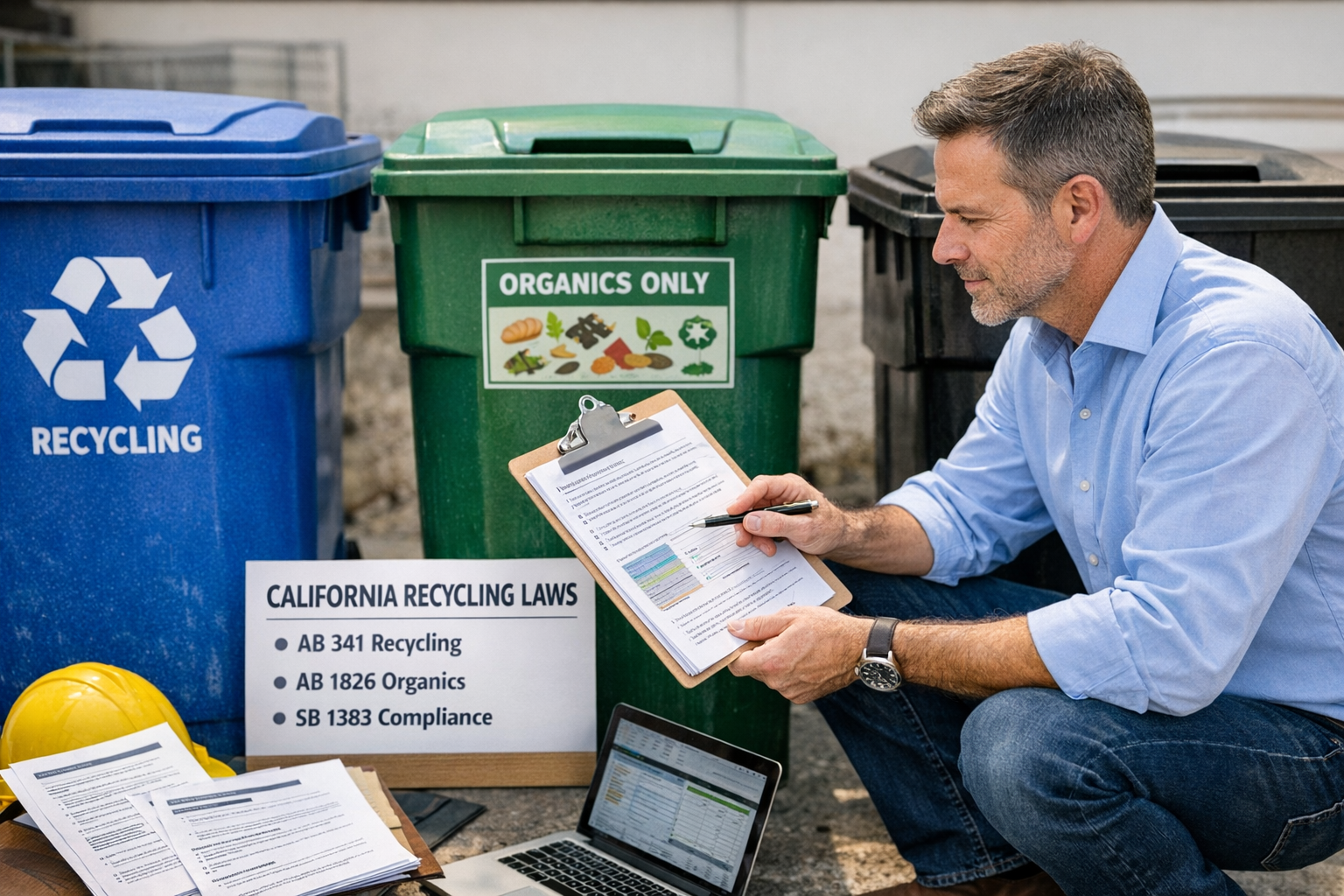
Let's be honest—keeping up with California's waste mandates feels like a full-time job. Between recycling rules, diversion requirements, and now organics separation, Sacramento-area businesses have a lot on their plates.
SB 1383 is the latest piece of the puzzle, and it's a big one. This law targets organic waste headed to landfills, and it applies to virtually every business in the state. The education period is over. Enforcement is ramping up through 2025, and penalties are real.
Here's what you actually need to know—in plain language—plus a practical checklist to get your compliance sorted in the next thirty to sixty days.
What SB 1383 Actually Requires
SB 1383, signed into law in 2016 with full enforcement beginning January 2022, targets short-lived climate pollutants. The goal: reduce organic waste in California landfills by 75 percent from 2014 levels by 2025 [1].
That's an aggressive target, and it means the state is serious about enforcement.
What Counts as "Organic Waste"
Under SB 1383, organic waste includes more than you might think:
Food scraps and food-soiled paper
Green waste and yard trimmings
Lumber and untreated wood
Textiles and carpet
Paper products and cardboard
If your business generates any of these materials—and most do—you're affected.
The Three Core Requirements
For most businesses, SB 1383 compliance comes down to three things:
1. Organic Waste Collection
You must subscribe to organic waste collection services. Your local jurisdiction determines the specific arrangements, but the obligation falls on you as the waste generator [2]. This means separating food waste, green waste, and other organics from your regular trash.
2. Edible Food Recovery (For Qualifying Businesses)
Certain businesses—called Tier One and Tier Two commercial edible food generators—must arrange for donation of edible food that would otherwise be discarded.
| Tier | Business Types | Compliance Deadline |
| Tier One | Supermarkets over 10,000 sq ft, food distributors, wholesale food vendors | January 2022 |
| Tier Two | Restaurants over 5,000 sq ft, hotels with 200+ rooms, large venues, health facilities | January 2024 |
If you fall into either category, food recovery isn't optional—it's required [3].
3. Record Keeping and Reporting
You need documentation showing compliance. This includes:
Proof of organic waste collection service
Food recovery agreements (if applicable)
Employee training records on proper sorting
When your jurisdiction conducts a compliance check, they'll want to see this paperwork.
How SB 1383 Fits With Your Existing Recycling Obligations
Here's where it gets confusing for a lot of Sacramento business owners: SB 1383 doesn't replace your other recycling requirements. It adds to them.
AB 341: Commercial Recycling (Still in Effect)
AB 341, effective since 2012, requires businesses generating four cubic yards or more of commercial solid waste per week to arrange for recycling services under AB 341 [4]. This covers traditional recyclables—cardboard, paper, metal, plastic.
That requirement hasn't changed. SB 1383 just adds organics on top of it.
AB 1826: Mandatory Commercial Organics Recycling (Superseded)
AB 1826, phased in between 2016 and 2019, required businesses generating specified amounts of organic waste to arrange for organic recycling [5]. SB 1383 supersedes and strengthens these requirements, applying to all businesses regardless of how much organic waste they generate.
In practical terms: if you were exempt from AB 1826 because of low volume, you're probably not exempt from SB 1383.
CALGreen Construction Requirements (Still in Effect)
Construction and demolition projects must divert at least 65 percent of materials from landfill disposal under CALGreen requirements [6]. SB 1383 reinforces this by including untreated wood and other construction organics in its scope.
The bottom line: If you're already compliant with AB 341 and were handling AB 1826, you have a foundation. SB 1383 expands your organics separation requirements and adds food recovery obligations for qualifying businesses.

What This Costs (The Reality Nobody Talks About)
Adding a green bin to your service typically increases your waste hauling bill. How much depends on your jurisdiction and hauler, but expect some cost impact.
That said, many businesses find the increase manageable—especially compared to the potential penalties for non-compliance. And if you're already paying for garbage pickup of materials that could be diverted, you may be able to offset some costs by right-sizing your landfill container.
The bigger challenge for many Sacramento businesses isn't cost—it's space. If you're operating out of a tight loading dock or small back-of-house area, finding room for another bin can be a real headache. To navigate these constraints, consider strategies for launching a recycling program with limited space.
Penalties for Non-Compliance
CalRecycle and local jurisdictions can impose penalties for SB 1383 violations. The enforcement structure allows for:
Notices of violation for initial non-compliance
Penalties ranging from $50 to $100 per day for first violations
Penalties up to $500 per day for repeat violations [7]
Many jurisdictions spent the first couple years focused on education and outreach. That grace period is ending. Enforcement is ramping up through 2025, and inspectors are actively checking compliance.
Waivers: Can You Get Out of This?
Limited waivers exist, but they're narrow:
De Minimis Waivers: If your business generates very small quantities of organic waste (typically less than 20 gallons per week, depending on your jurisdiction), you may qualify for a de minimis waiver.
Physical Space Waivers: If you genuinely lack physical space for additional containers and can document it, you may qualify for a space waiver.
Waivers must be requested through your local jurisdiction and are subject to verification [9]. They're not automatic, and your jurisdiction can revoke them if circumstances change.
Reality check: Most businesses don't qualify. If you have a break room, generate food waste, or receive deliveries with packaging, you're probably producing enough organic material to require compliance.

Your Thirty to Sixty Day Compliance Checklist
Getting compliant doesn't mean overhauling everything overnight. Here's a prioritized approach.
Week One: Figure Out Where You Stand
Determine your business category. Are you a Tier One or Tier Two edible food generator? This determines whether you have food recovery obligations beyond basic organics collection.
Review your current waste services. Pull out your hauler contract. Do you have organic waste collection? Many haulers added green bin service over the past few years—you might already have it and not be using it properly.
Check your local jurisdiction's requirements. Sacramento County rules may differ slightly from the City of Sacramento or surrounding cities. Your local jurisdiction may have additional requirements or specific hauler arrangements. Check your city or county environmental services department website for specifics.
Week Two: Close Any Service Gaps
Set up organic waste collection if you don't have it. Contact your hauler to add services. In some jurisdictions, this is mandatory through your existing hauler—you may not have a choice of providers.
Get the right containers. California standardizes container colors: green for organics, blue for recyclables, gray or black for landfill trash [8]. Using the wrong colors creates confusion and contamination.
Designate collection areas. Figure out where organic waste containers will go. High-generation areas—kitchens, break rooms, food prep areas—need nearby bins. If space is tight, this is where you'll need to get creative.
Weeks Three and Four: Train Your People and Document Everything
Train your employees. Staff need to know what goes where. This doesn't need to be elaborate—clear signage and a brief meeting often work. Focus on the items your business generates most frequently.
Post visual sorting guides. Put them near waste stations. Include items specific to your operation, not just generic examples.
Set up your record-keeping system. Keep copies of your hauler contract, any food recovery agreements, and documentation of employee training. Create a folder—physical or digital—so you can produce these documents quickly if someone asks.
Weeks Five Through Eight: Handle Food Recovery (If Applicable)
Identify food recovery organizations. If you're a Tier One or Tier Two generator, contact local food banks or food recovery organizations to establish donation agreements. Many jurisdictions maintain lists of approved organizations.
Work out the logistics. Determine pickup schedules, storage requirements, and handling procedures. Food safety rules apply to donated items—you can't just throw things in a box.
Track and document. Record quantities donated and maintain records of your food recovery agreements.

What Goes Where: A Quick Reference
The distinction between SB 1383 organics and traditional recyclables matters for compliance.
SB 1383 Organic Waste (Green Bin)
| Category | Examples |
| Food waste | Scraps, spoiled food, coffee grounds, eggshells |
| Food-soiled paper | Pizza boxes, napkins, paper towels, paper plates |
| Green waste | Landscape trimmings, grass clippings |
| Wood | Untreated lumber, pallets (check with hauler) |
| Textiles | Clothing, fabric scraps (check with hauler) |
Traditional Recyclables (Blue Bin)
| Category | Examples |
| Metals | Scrap steel, aluminum cans, copper, brass |
| Cardboard | Clean, dry cardboard (not food-soiled) |
| Paper | Office paper, newspaper, magazines |
| Plastics | Bottles, containers with recycling codes |
| Glass | Bottles, jars |
Key distinction: Clean cardboard goes in recycling. Food-soiled cardboard (like a greasy pizza box) goes in organics.
Your scrap metal and clean cardboard continue following the recycling stream you likely already have in place. SB 1383 adds the organics stream alongside your existing recycling practices.

The Recyclables Side: What Willis Recycling Handles
While SB 1383 focuses on organics, your traditional recycling obligations remain fully in effect. AB 341 requirements for commercial recycling haven't changed. Construction projects still must meet CALGreen diversion requirements.
Organics collection falls outside our core services at Willis Recycling—we specialize in scrap metal and cardboard recycling. But we understand how SB 1383 fits into your broader compliance picture, and we're often working alongside organics haulers to help Sacramento businesses manage their complete waste diversion strategy. For a more detailed look at how these roles differ, consider the distinction between a waste hauler versus a recycling partner.
Here's what we do handle:
For the traditional recyclables side of your waste stream—scrap metal, clean cardboard, and other non-organic recyclables—our on-site pickup services provide the documentation you need to demonstrate proper diversion. Weight tickets and itemized records show that your metals and cardboard are being recycled properly, which supports your overall compliance picture.
When we pick up your scrap metal and cardboard bales, you're freeing up space on your loading dock. For businesses struggling to fit another bin for organics, getting the cardboard and metal out of the way on a regular schedule can make the difference.
Common Questions About SB 1383
Does this apply to small businesses?
Yes. Unlike some previous regulations that exempted small generators, SB 1383 applies to all businesses regardless of size. A single-employee office generates less organic waste than a large restaurant, but the basic requirement to separate organics applies to both.
What if my waste hauler doesn't offer organics collection?
Contact your local jurisdiction's environmental services department. Many areas have established hauler requirements, and your jurisdiction can direct you to available options. Some areas allow shared collection arrangements for very small generators.
Can I self-haul organic waste?
Self-hauling is permitted under certain conditions, but you must deliver materials to approved facilities and maintain documentation. For most businesses, arranging service through a licensed hauler is simpler than managing self-haul logistics and paperwork.
What about multi-tenant buildings?
Property owners or managers typically bear responsibility for providing organic waste collection services in multi-tenant commercial buildings. As an individual tenant, you must use the provided services correctly. If your building doesn't have organics collection, talk to your property manager—they may not realize they're out of compliance.
My jurisdiction hasn't contacted me about this. Am I really required to comply?
Yes. The law applies statewide regardless of whether your specific jurisdiction has reached out to you. Some jurisdictions are more proactive about outreach than others, but lack of contact doesn't mean lack of obligation.
Ready to Address the Recyclables Side?
SB 1383 adds new obligations, but the fundamentals of responsible waste management remain consistent: separate materials properly, work with reliable service providers, and maintain documentation.
For the recyclables portion of your waste stream—scrap metal, cardboard, and other traditional recyclables—Willis Recycling provides on-site pickup services throughout the Sacramento region. We bring the equipment, handle the heavy lifting, and provide the documentation you need for compliance records.
Call us at (916) 271-2691 to schedule a pickup or discuss how we can help with your recyclables management.
Frequently Asked Questions
Does SB 1383 replace my existing recycling requirements under AB 341?
No. SB 1383 adds organic waste requirements on top of existing commercial recycling obligations. You still must arrange for recycling of traditional materials like cardboard, paper, and metals under AB 341. Think of it as another layer—SB 1383 expands your responsibilities to include food waste, green waste, and other organics, while everything else stays the same.
What happens if my business only generates small amounts of organic waste?
SB 1383 applies regardless of quantity, but your local jurisdiction may offer de minimis waivers for businesses producing very little organic waste—typically less than 20 gallons per week. Contact your city or county environmental services department to determine whether a waiver application makes sense for your situation. Be prepared to document your waste generation levels.
How do I document compliance for a potential inspection?
Maintain copies of your waste hauler contracts showing organic waste collection services, any food recovery agreements if you qualify as a Tier One or Tier Two generator, and records of employee training on proper sorting. Weight tickets and pickup receipts from your hauler also demonstrate ongoing compliance. Keep everything organized in one place so you can produce it quickly.
Can Willis Recycling help with the organics side of SB 1383?
Organics collection falls outside our core services—we specialize in scrap metal and cardboard recycling. However, we help Sacramento businesses stay compliant on the traditional recyclables side. Our on-site pickup services provide documentation showing proper handling of metals and cardboard, which supports your overall waste diversion compliance picture.
When should I contact my local jurisdiction about SB 1383?
Contact your city or county environmental services department if you have questions about local requirements, need to request a waiver, or cannot determine the approved organics haulers in your area. Each jurisdiction implements SB 1383 slightly differently, so local guidance often provides the clearest answers for your specific situation.
About Willis Recycling
Willis Recycling is a family-owned mobile recycling service serving Sacramento and Northern California businesses since 2017. With nearly two decades of combined industry experience, our team provides on-site scrap metal and cardboard pickup for construction firms, retail operations, healthcare facilities, and other commercial clients. We handle the logistics—showing up on time, loading materials safely, and providing transparent documentation—so you can focus on running your business.
Cited Works
CalRecycle — "Short-Lived Climate Pollutants (SLCP): Organic Waste Reductions." https://calrecycle.ca.gov/organics/slcp/
CalRecycle — "SB 1383 Regulations." https://calrecycle.ca.gov/organics/slcp/regulations/
CalRecycle — "Edible Food Recovery." https://calrecycle.ca.gov/organics/slcp/education/foodrecovery/
CalRecycle — "Commercial Recycling Requirements (AB 341)." https://calrecycle.ca.gov/recycle/commercial/
CalRecycle — "Mandatory Commercial Organics Recycling (AB 1826)." https://calrecycle.ca.gov/recycle/commercial/organics/
California Building Standards Commission — "CALGreen Code." https://www.dgs.ca.gov/BSC/CALGreen
CalRecycle — "SB 1383 Enforcement." https://calrecycle.ca.gov/organics/slcp/enforcement/
CalRecycle — "Container Color Requirements." https://calrecycle.ca.gov/organics/slcp/collection/containerlabels/
CalRecycle — "SB 1383 Waivers." https://calrecycle.ca.gov/organics/slcp/collection/waivers/